Software and AI engineer building full-stack applications, APIs, AI integrations, and business automation. B.S. in Computer Science from the University of Central Florida; founder and lead engineer at CoreTV.
My work spans applied AI, full-stack and backend development, and cloud operations. These are the core tools from my resume, with public projects below for a closer look.
AI & agent systems
Agent orchestration, LLM integration, and reusable input-isolation and usage-authorization contracts.
Python
TypeScript
LLM integration
AI automation
pgvector
Explore Coretex's agent workspace and Core AI's public TypeScript contracts.
8 public software projects are gathered here with their implementation notes, screenshots, demos, and source links. Open a project’s notes to review its full write-up.
AI agents · Desktop & backend
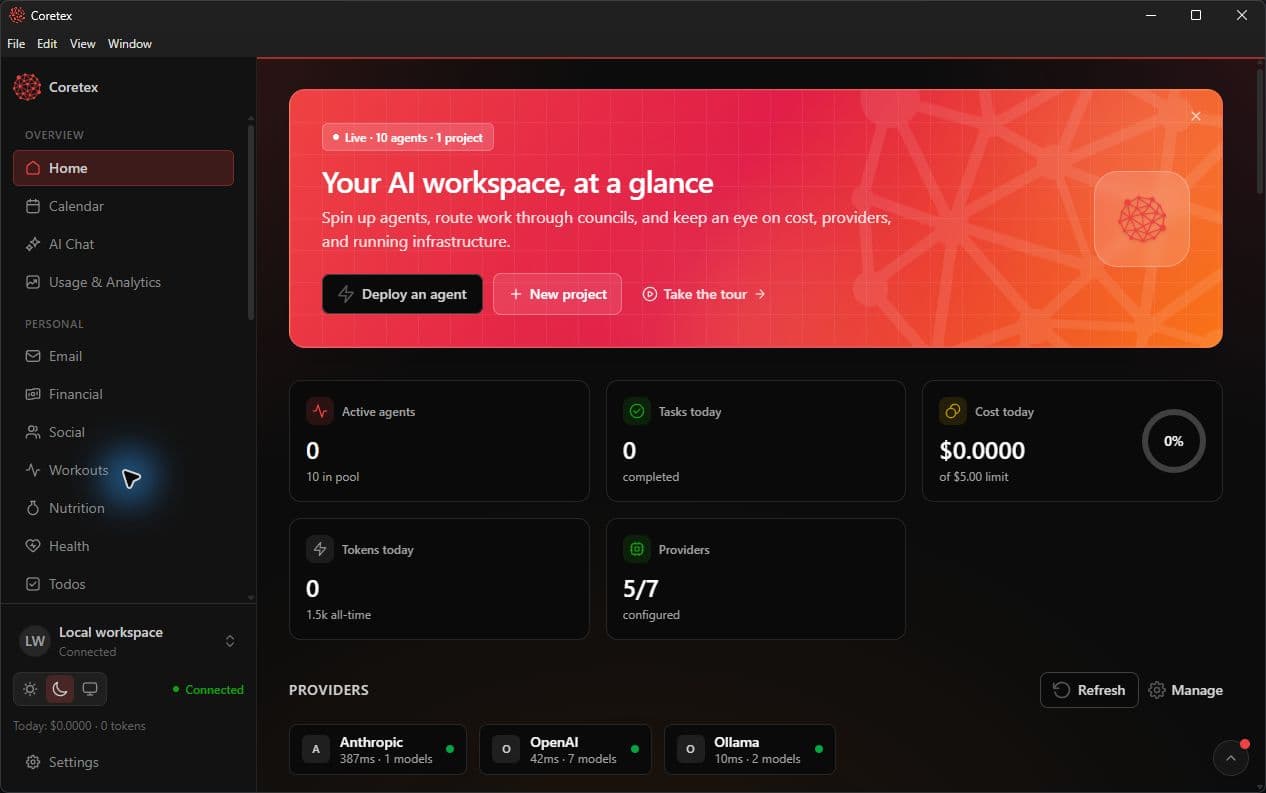
Coretex
Pre-1.0 · Source available
A local-first workspace for AI agents, projects, productivity, personal analytics, and developer operations.
Coretex brings the tools used to run work and life into one focused Windows desktop app. It combines agent orchestration, project planning, communication, local infrastructure, and personal tracking behind a responsive React interface.
A local-first workspace bringing AI agents, projects, communication, personal analytics, and developer operations into a Windows desktop application.
Contribution & implementation
Built and maintain the desktop and web workspace, its shared React application layer, and the TypeScript Brain service that connects agent work with integrations and local operations.
Engineering approach
Share the application layer across Electron and Next.js clients so core workflows stay consistent.
Use PostgreSQL and Prisma in the Brain service, with Docker-backed local development.
Keep credentials and local application data outside the public repository.
Bring agent orchestration, project planning, communications, and personal tracking into one local-first workspace.
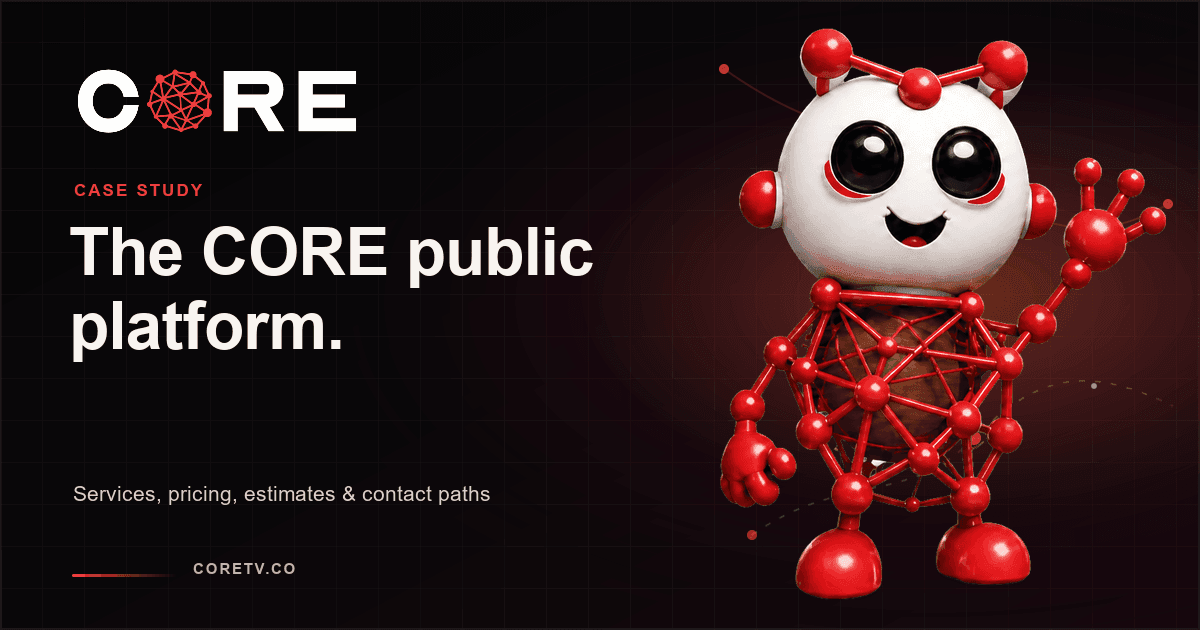
The public CORE Business Technology platform for websites, growth, AI, automation, and workplace technology.
CoreTV.co brings services, pricing, estimates, booking, contact, and client access into one responsive product experience. This entry outlines the public platform while linking the reusable Core AI safety contracts repository behind the private product systems.
The public CORE Business Technology platform brings web services, growth, AI, automation, and workplace technology into one responsive experience.
Contribution & implementation
The platform connects service discovery to package pricing, custom estimates, booking, contact, and client access. Its public delivery model documents six reviewable stages: Audit, Proposal, Design, Build, Launch, and Growth.
Engineering approach
Present services and pricing alongside clear scope, exclusions, and review points.
Make the path from learning about a service to requesting an estimate or booking easy to follow.
Keep the public case study inspectable while private providers, policies, prompts, and customer data remain private.
Link the product to a separate, provider-neutral Core AI contracts package for input isolation and usage authorization.
The GitHub repository linked here is Core AI: a provider-neutral TypeScript package for input isolation, metered chat, voice, and embedding authorization, and safety contracts.
Product deployments pair these reusable contracts with CORE’s private policies, providers, prompts, and data services; those private implementation details are intentionally not published in this entry.
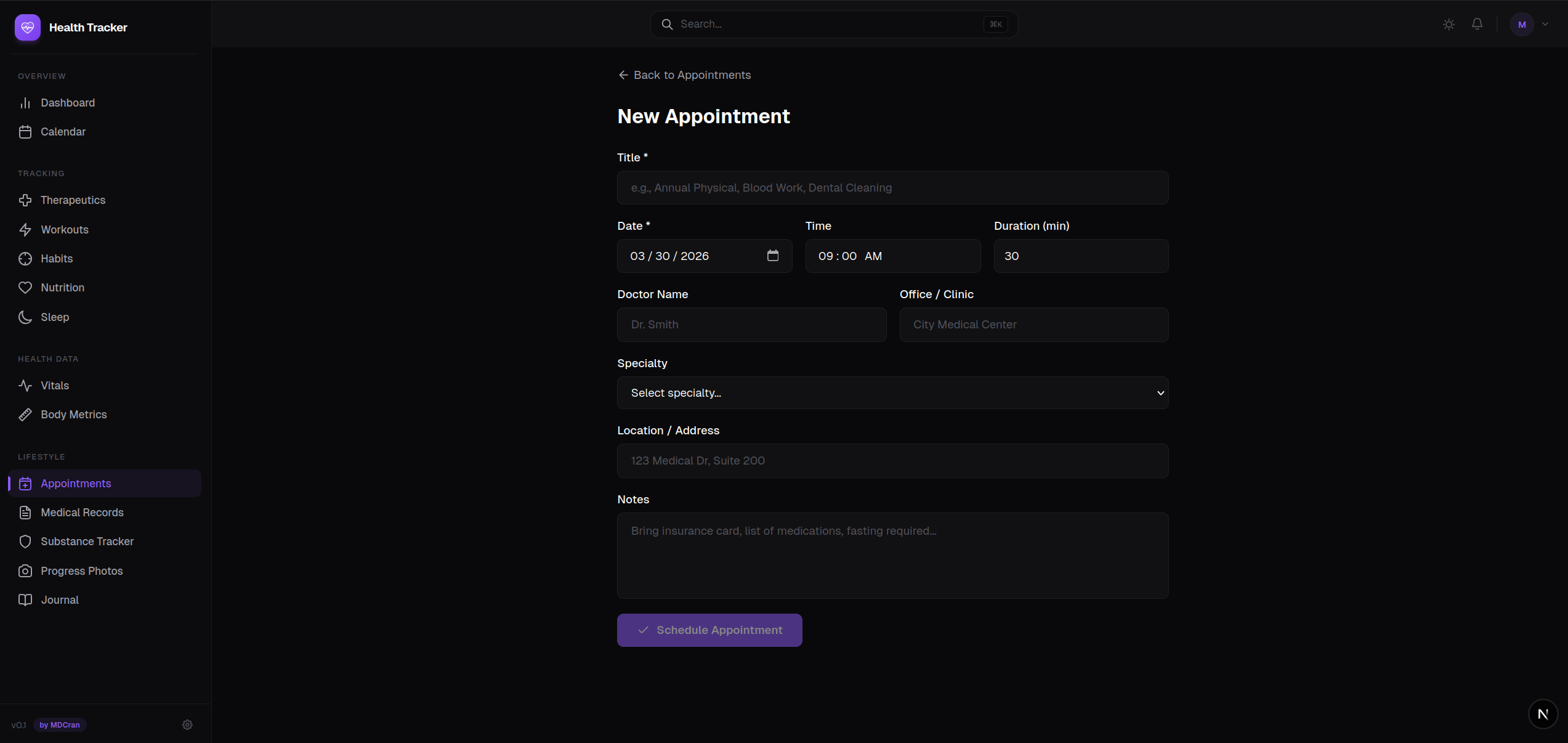
Live at healthtracker.mdcran.com · Source available
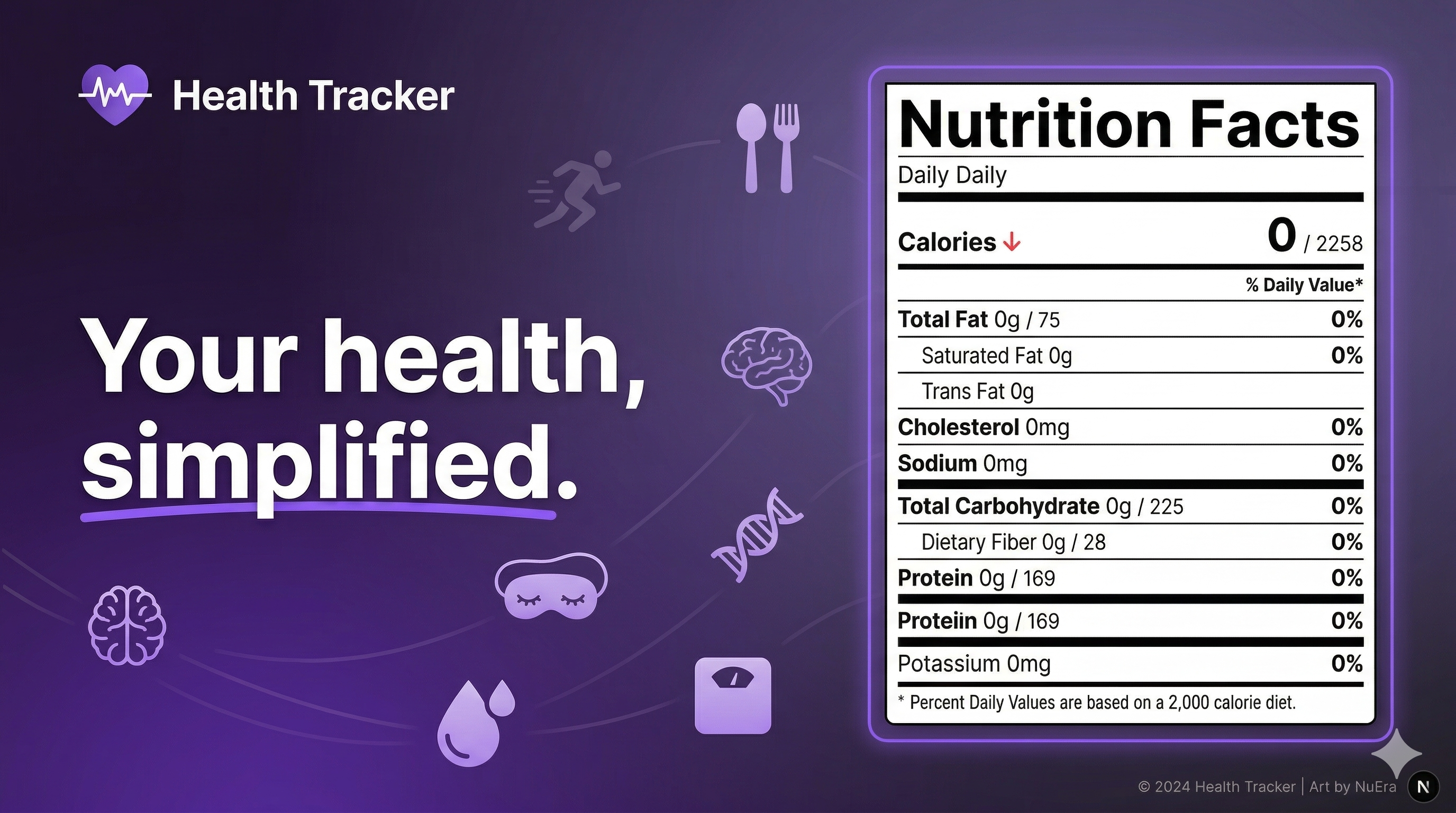
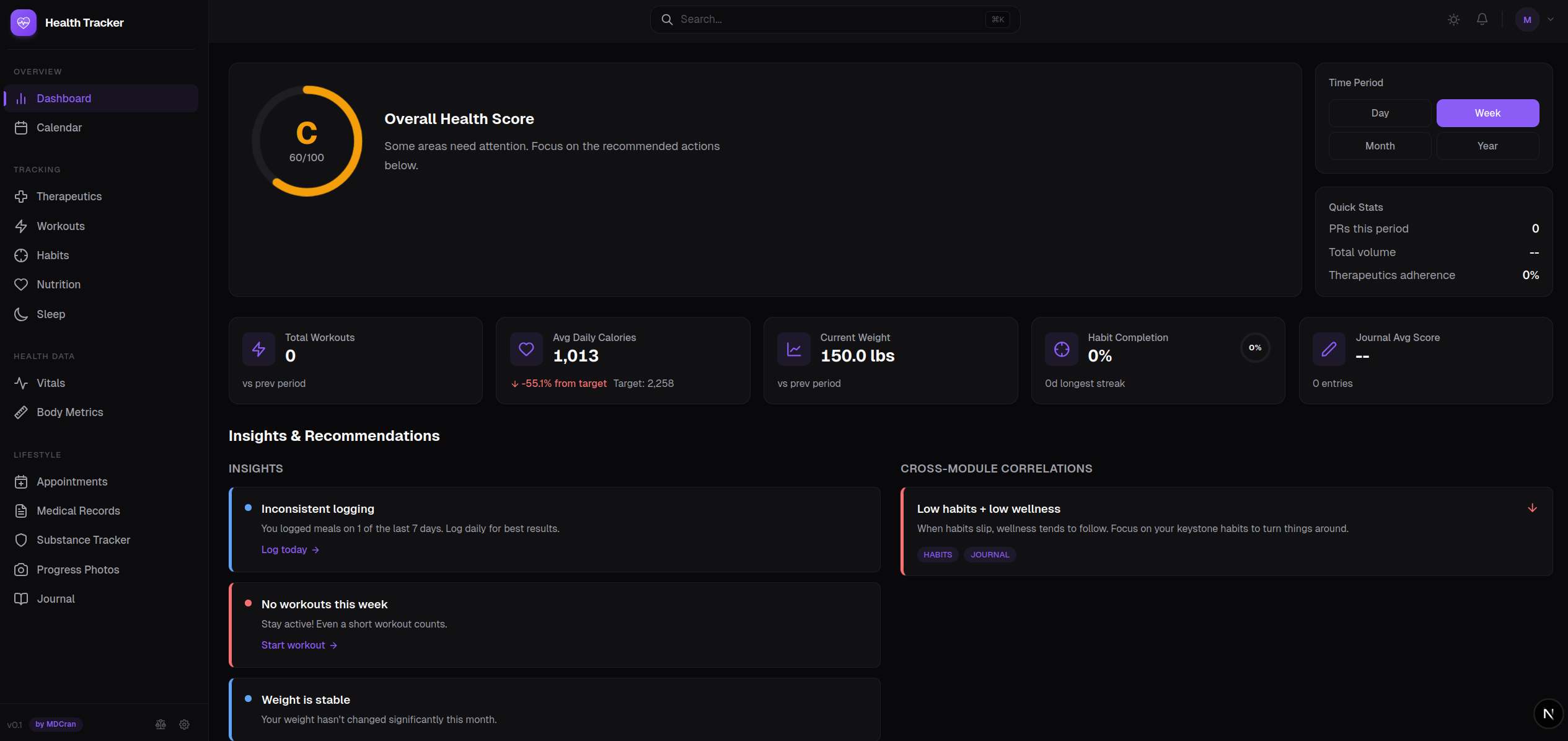
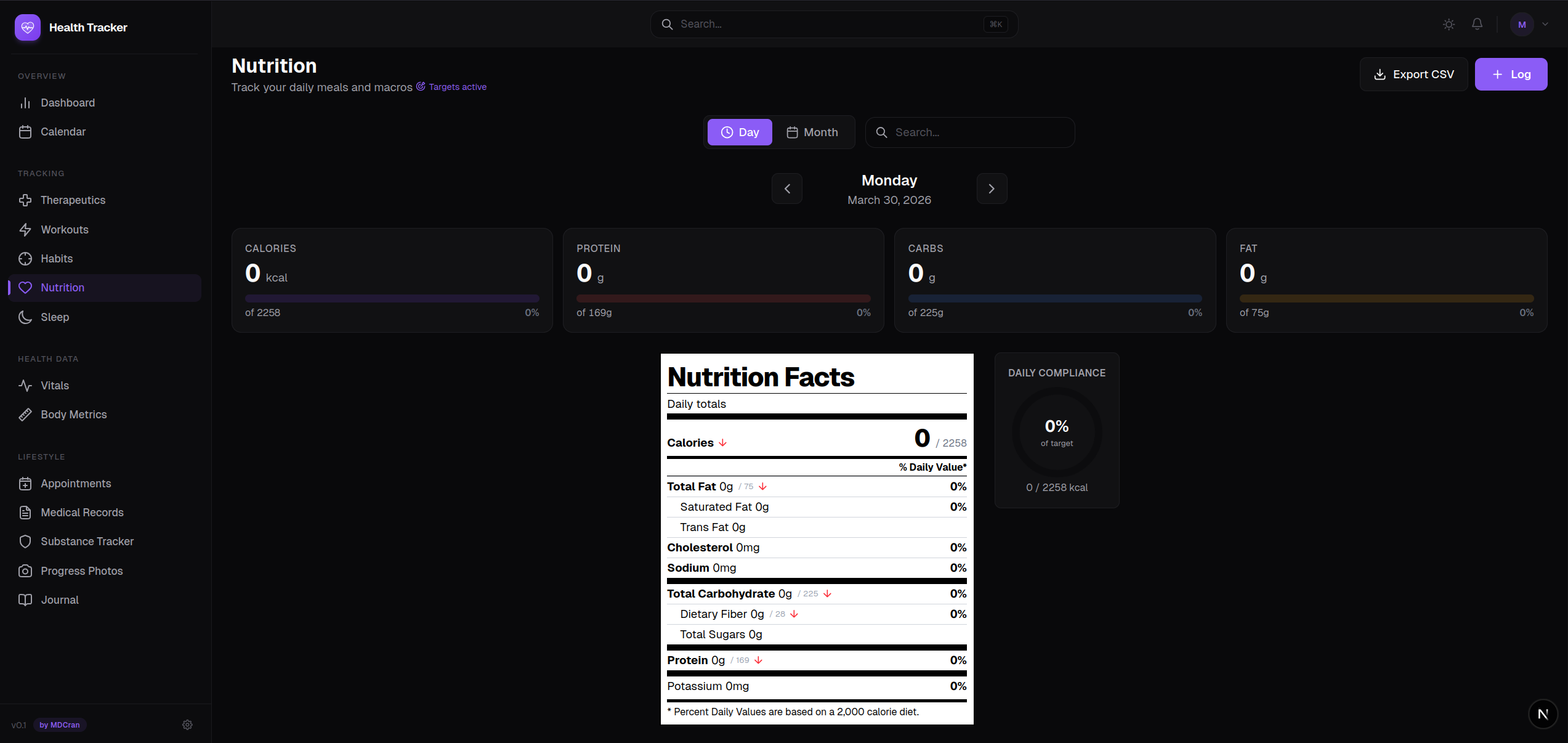
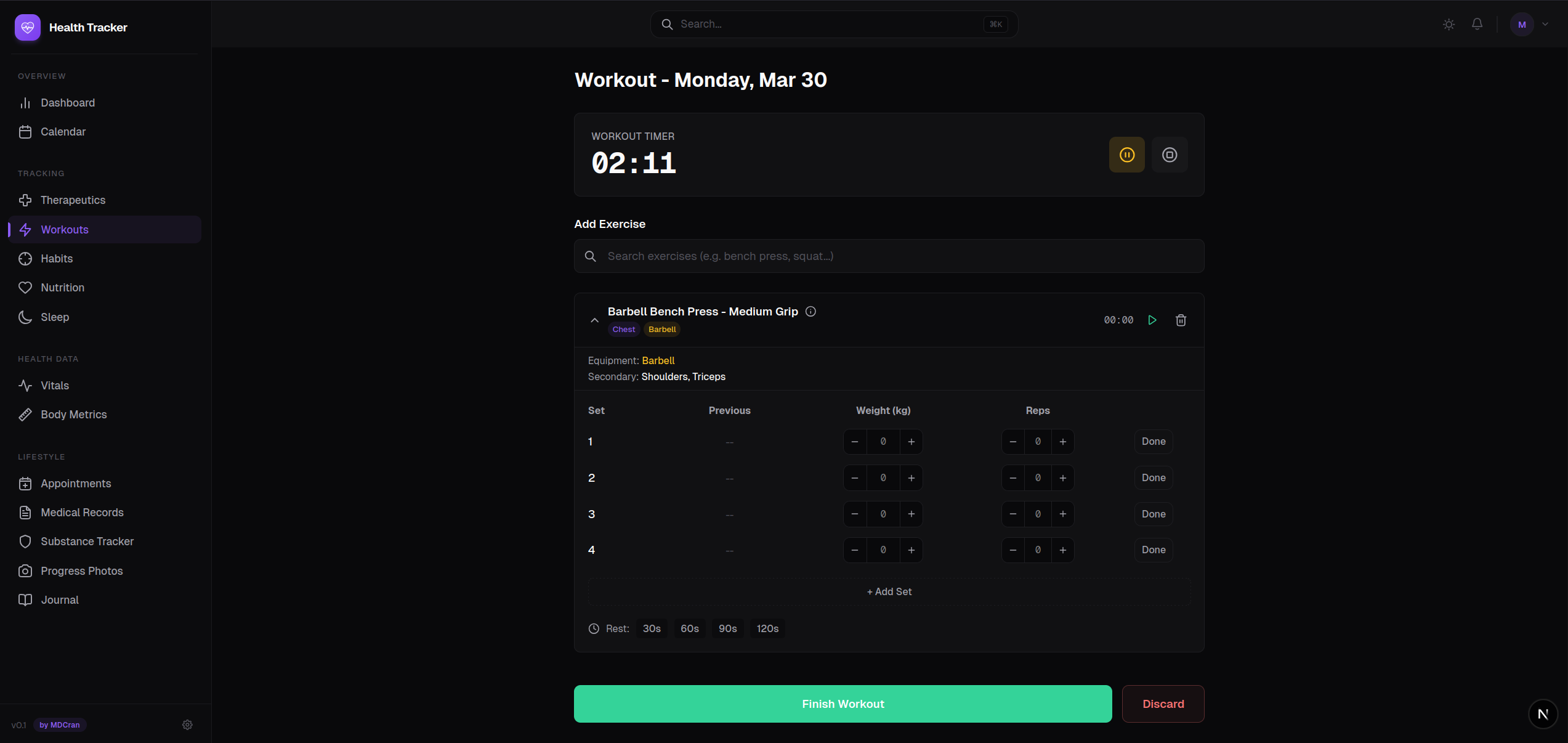
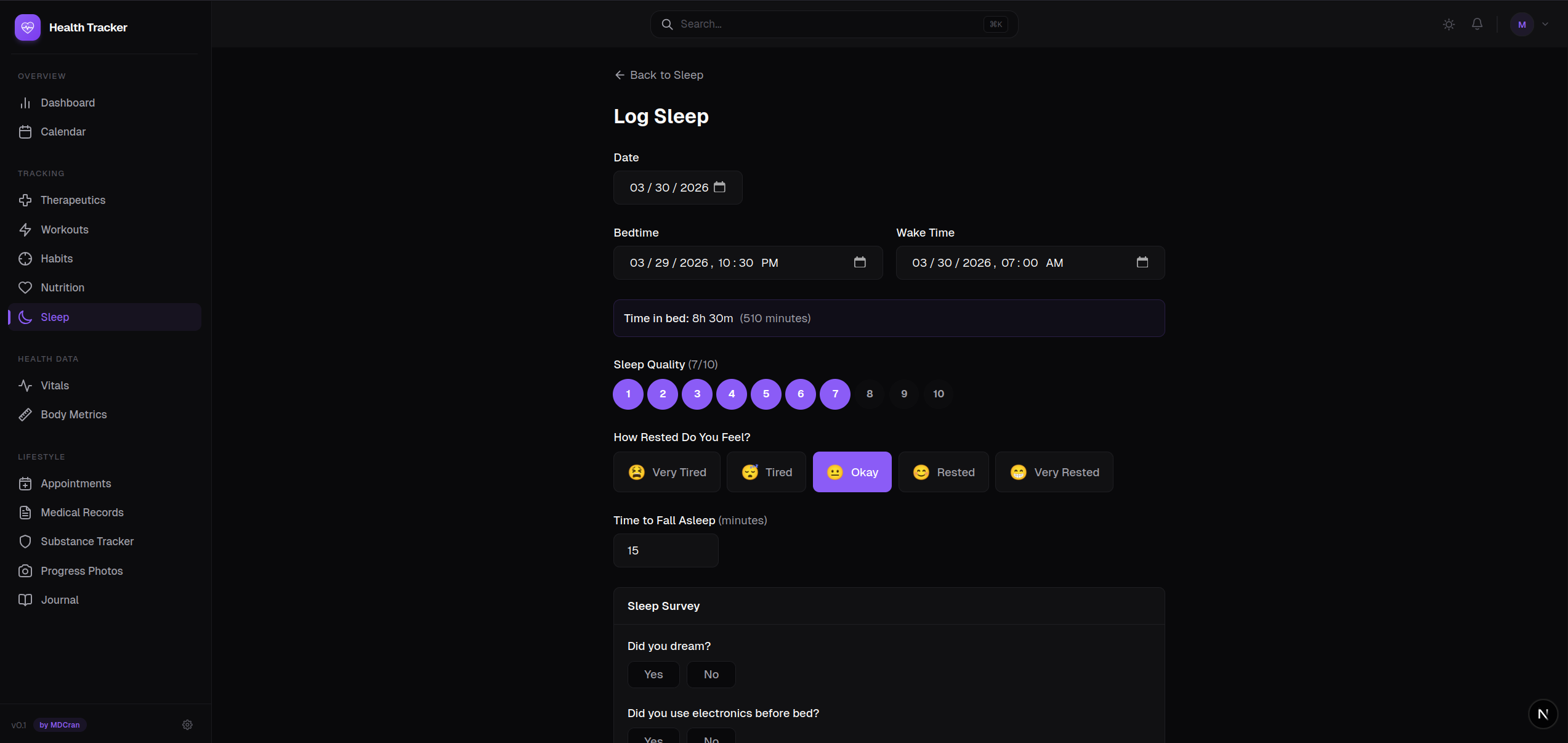
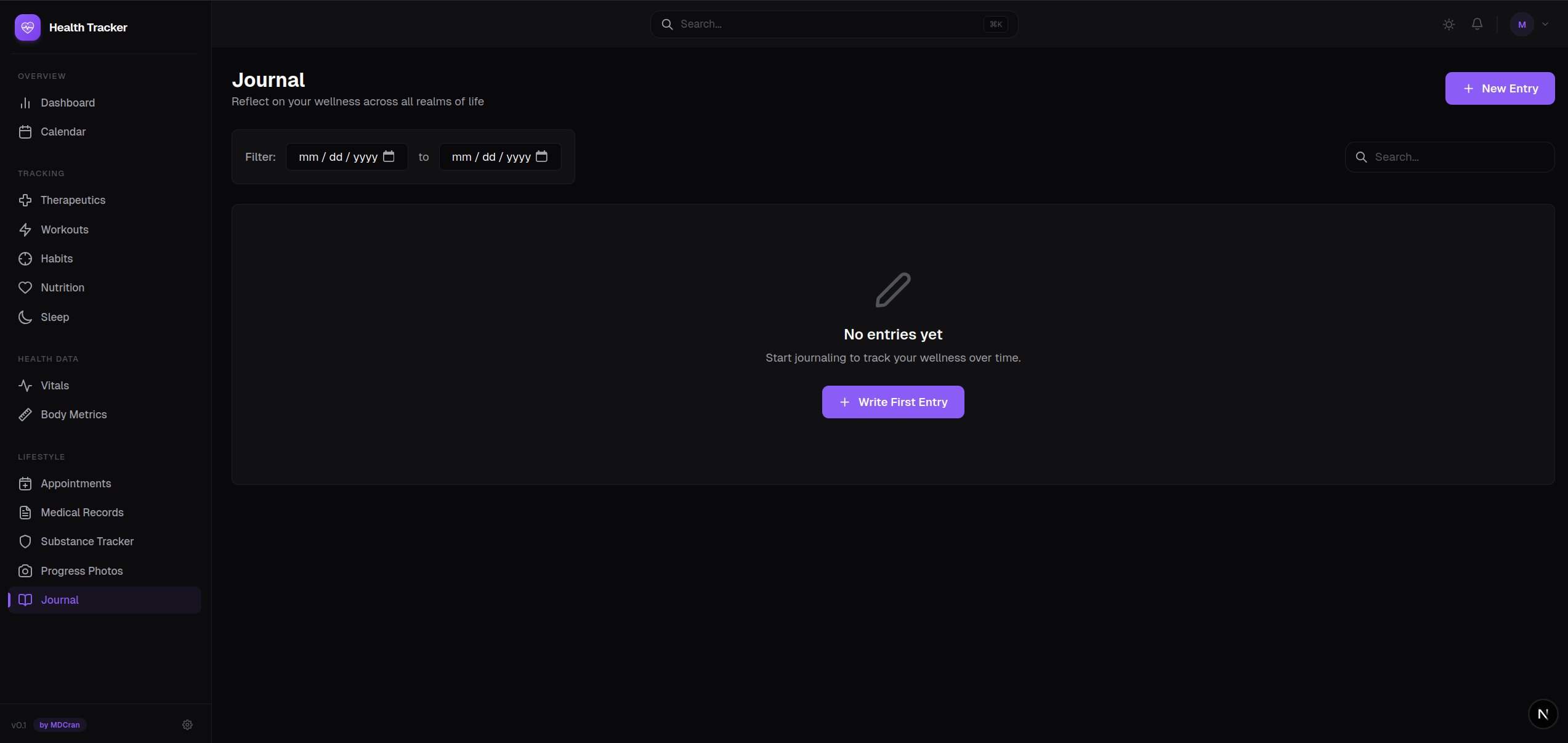
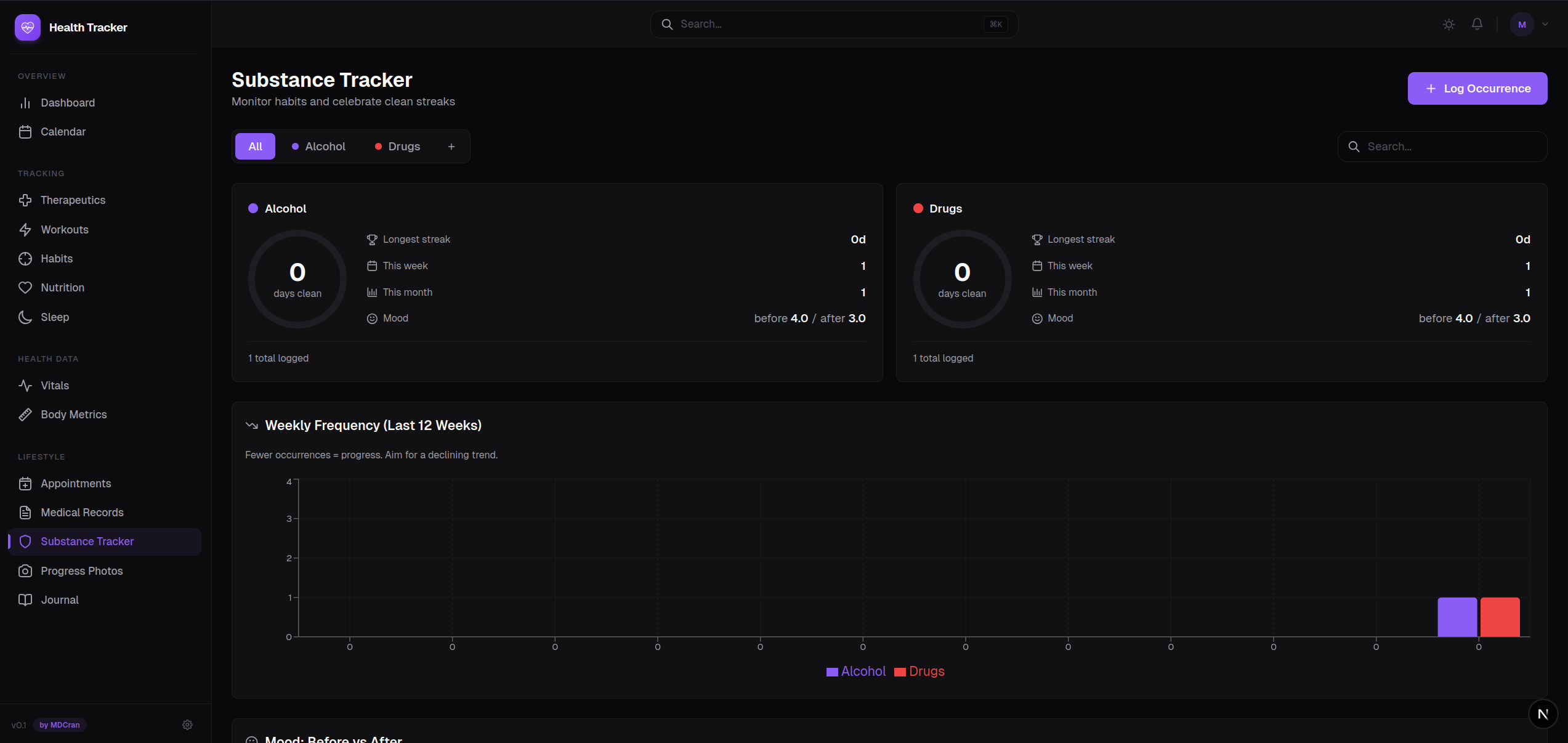
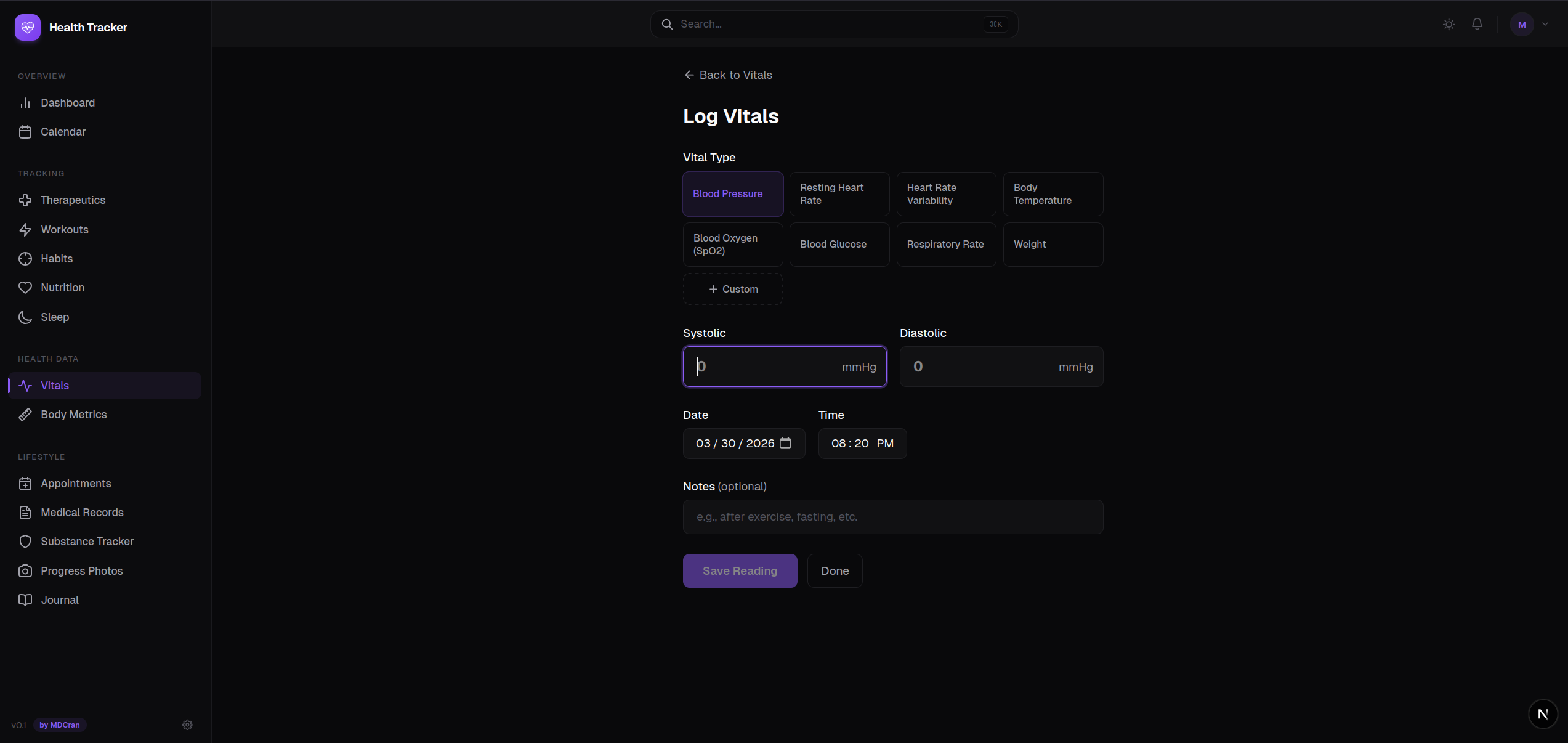
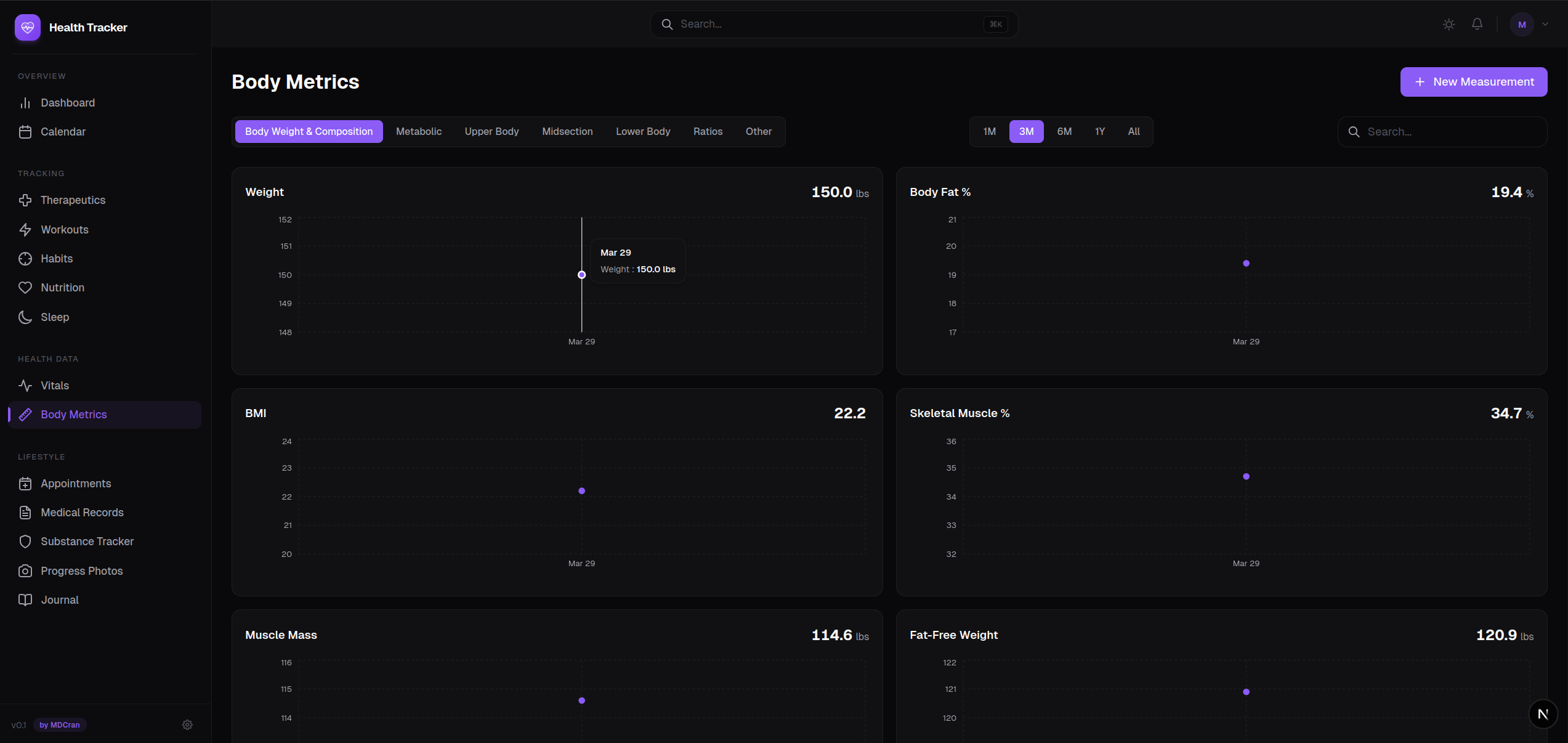
A comprehensive wellness platform to track workouts, nutrition, sleep, vitals, habits, therapeutics, appointments, and body metrics — with AI food analysis, Google Drive storage, and exportable health reports.
A personal health platform for workouts, nutrition, sleep, vitals, habits, therapeutics, appointments, and body metrics, with AI food analysis and exportable reports.
Contribution & implementation
Built the Next.js frontend and Spring Boot backend around a unified dashboard. The application supports Google Drive backups, AI-assisted health insights, PDF reports, CSV exports with date ranges, and containerized deployment.
Engineering approach
Separate the Next.js frontend from the Spring Boot API and persist relational data in PostgreSQL with Flyway migrations.
Use Docker to package the services and document the local setup for reviewers.
Support both structured export (CSV) and readable health summaries (PDF) across customizable date ranges.
Keep health data flows understandable across tracking, AI insight, backup, and export features.
A full-stack personal health management platform built with Spring Boot and Next.js that consolidates fitness, nutrition, medical, and wellness tracking into a single unified dashboard.
The platform integrates with Google Drive for backups, generates AI-powered health insights across all modules, and supports PDF report exports and CSV data exports with customizable date ranges. The backend runs on Spring Boot with PostgreSQL and Flyway migrations, while the frontend is a Next.js application — both containerized with Docker and deployed on Render.
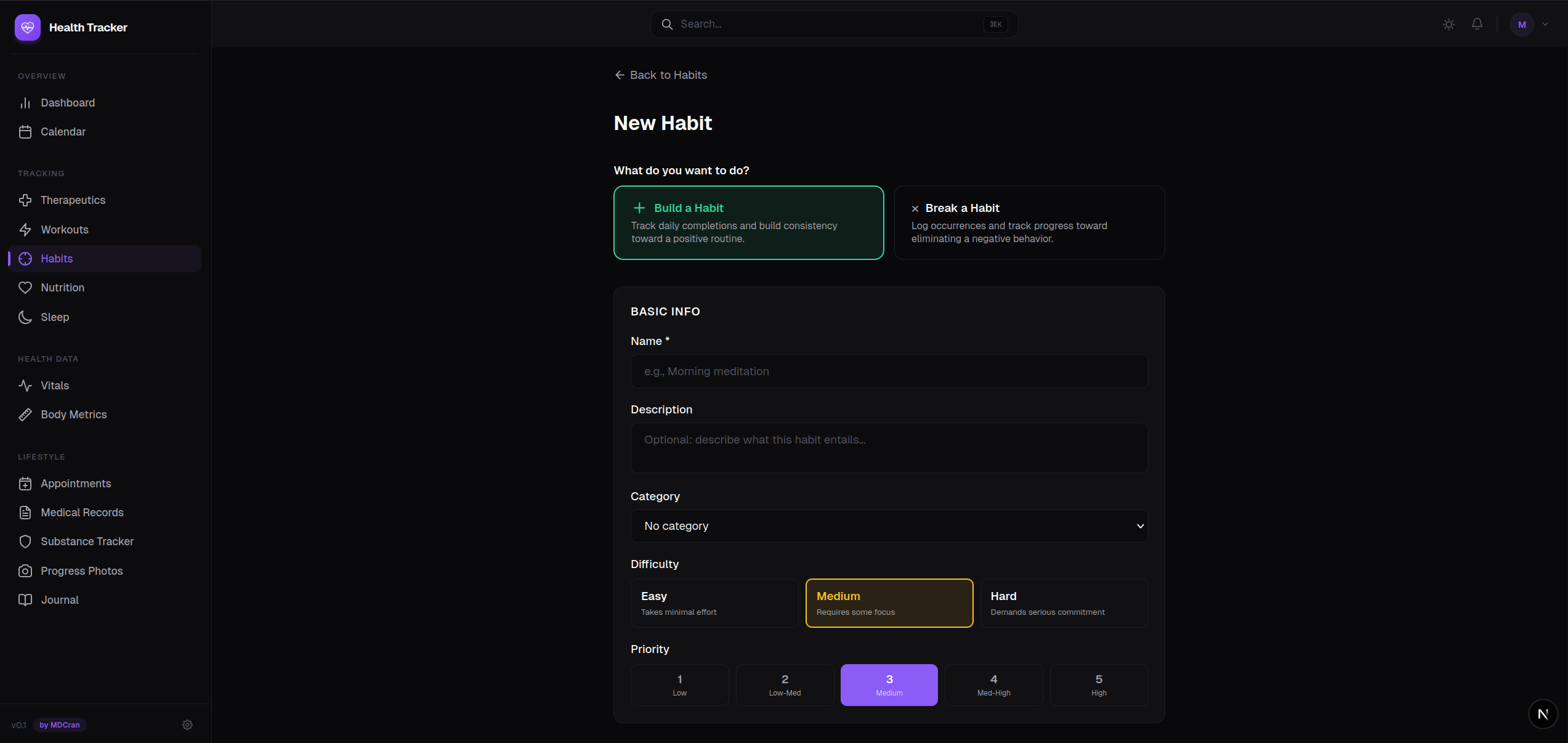
The application tracks workouts with personal records and exercise history, logs daily nutrition with AI-powered food image analysis, monitors vitals like blood pressure and heart rate, and manages body metrics, sleep patterns, and progress photos over time. It also includes a therapeutics module for medications, supplements, and peptides, a habit tracker with streaks and milestones, a journal with mood scoring, substance use logging, appointment scheduling, and medical document storage.
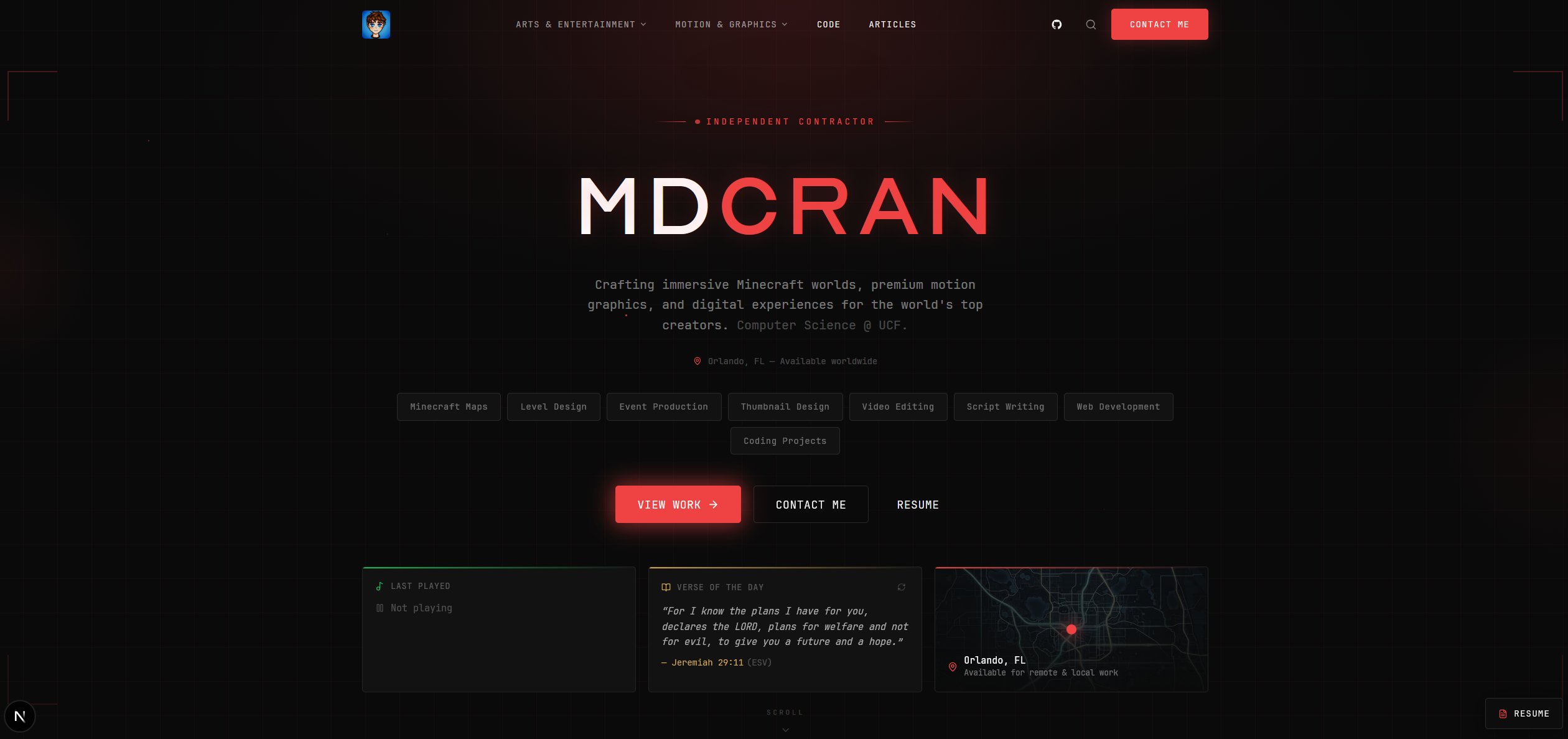
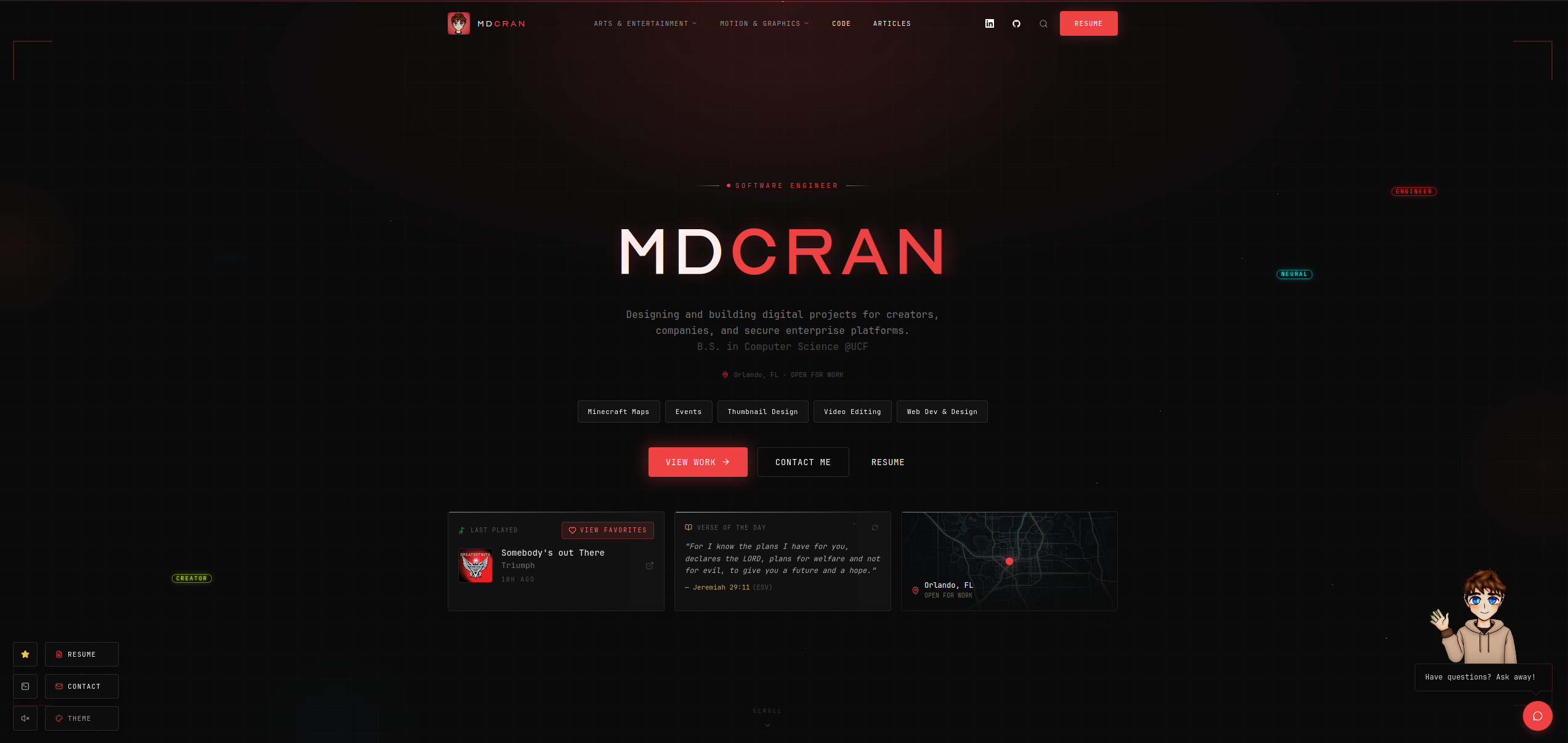
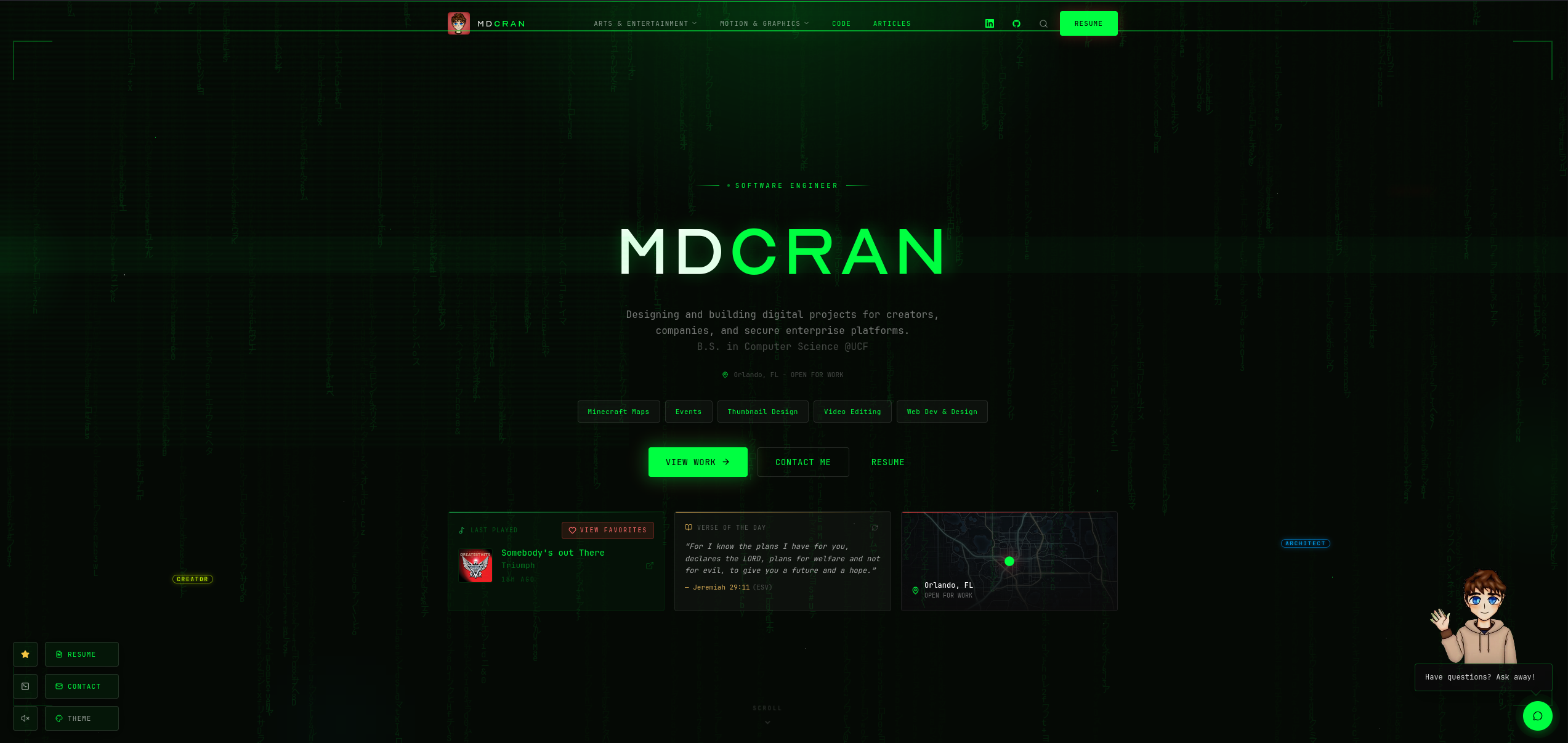
The current MDCran portfolio website — built with Next.js, Tailwind v4, shadcn/ui, and framer-motion.
The application behind this site: a responsive portfolio with managed content, API integrations, streaming AI chat, voice features, and analytics.
Contribution & implementation
Designed, built, and maintain the Next.js application and its content, portfolio, analytics, and integration routes. The project record also documents the visitor experience through screenshots and a terminal-mode demo.
Engineering approach
Use server-rendered pages alongside interactive React components for browsing and live experiences.
Store editable portfolio content in MongoDB and expose public data through focused API routes.
Integrate streaming chat and speech services through server-side routes so provider credentials stay on the server.
Treat accessibility, screen-reader support, theme controls, and responsive layouts as part of the site experience.
Web Design
Next.js
Portfolio
Frontend
React
TypeScript
MongoDB
REST APIs
AI integrations
Accessibility
Full project notes, screenshots & demos +−17 project sections
Home Page
Homescreen Hero Section
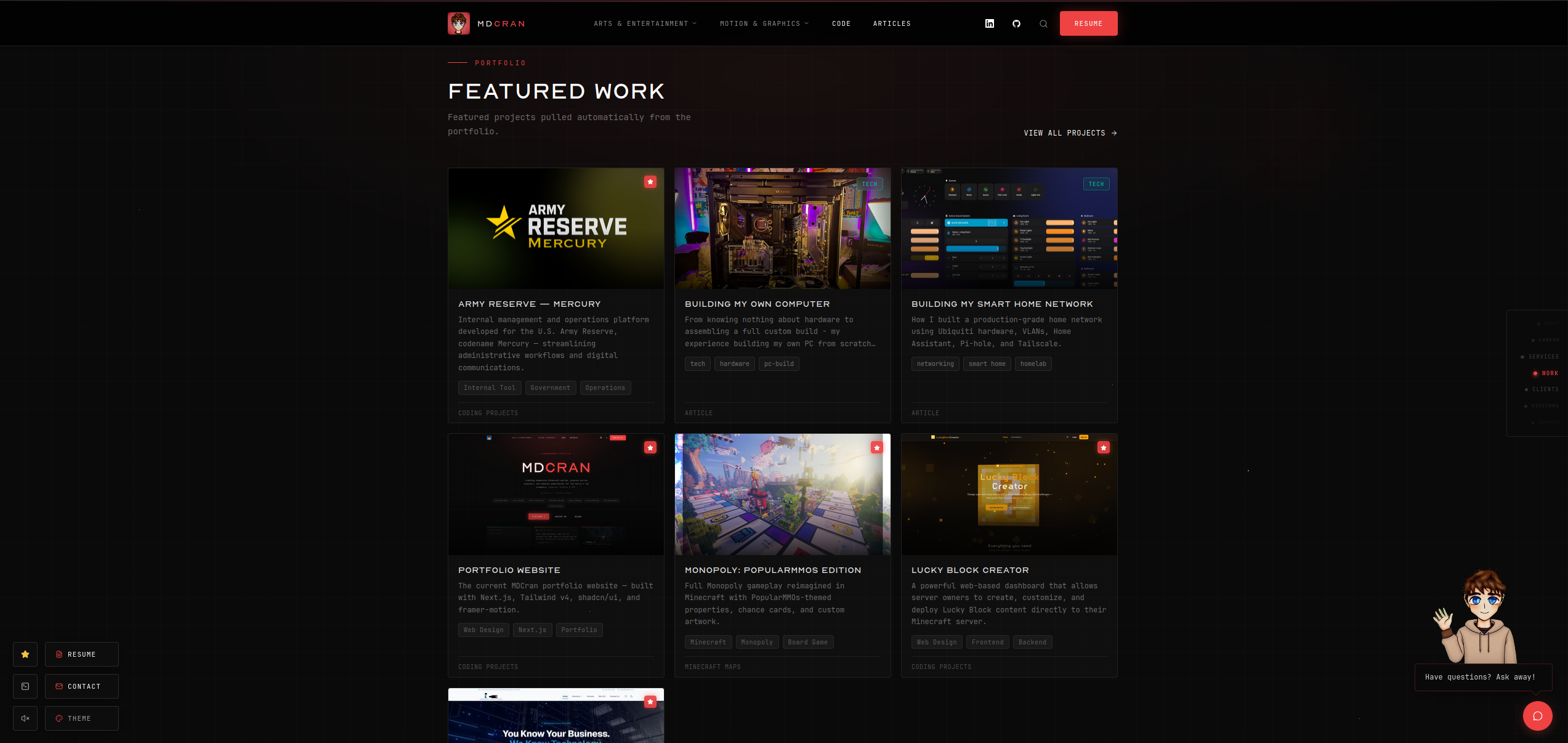
Featured Work
Showcase of Featured Projects
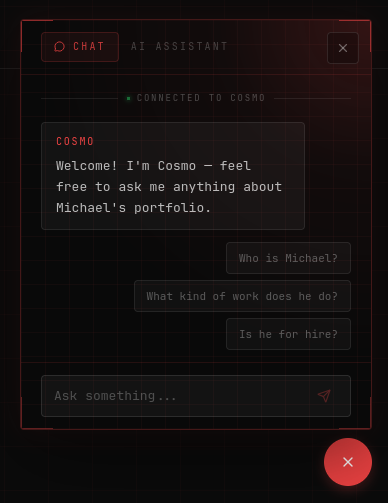
AI Chat Bot
Context-Aware AI Chatbot (Site-Wide)
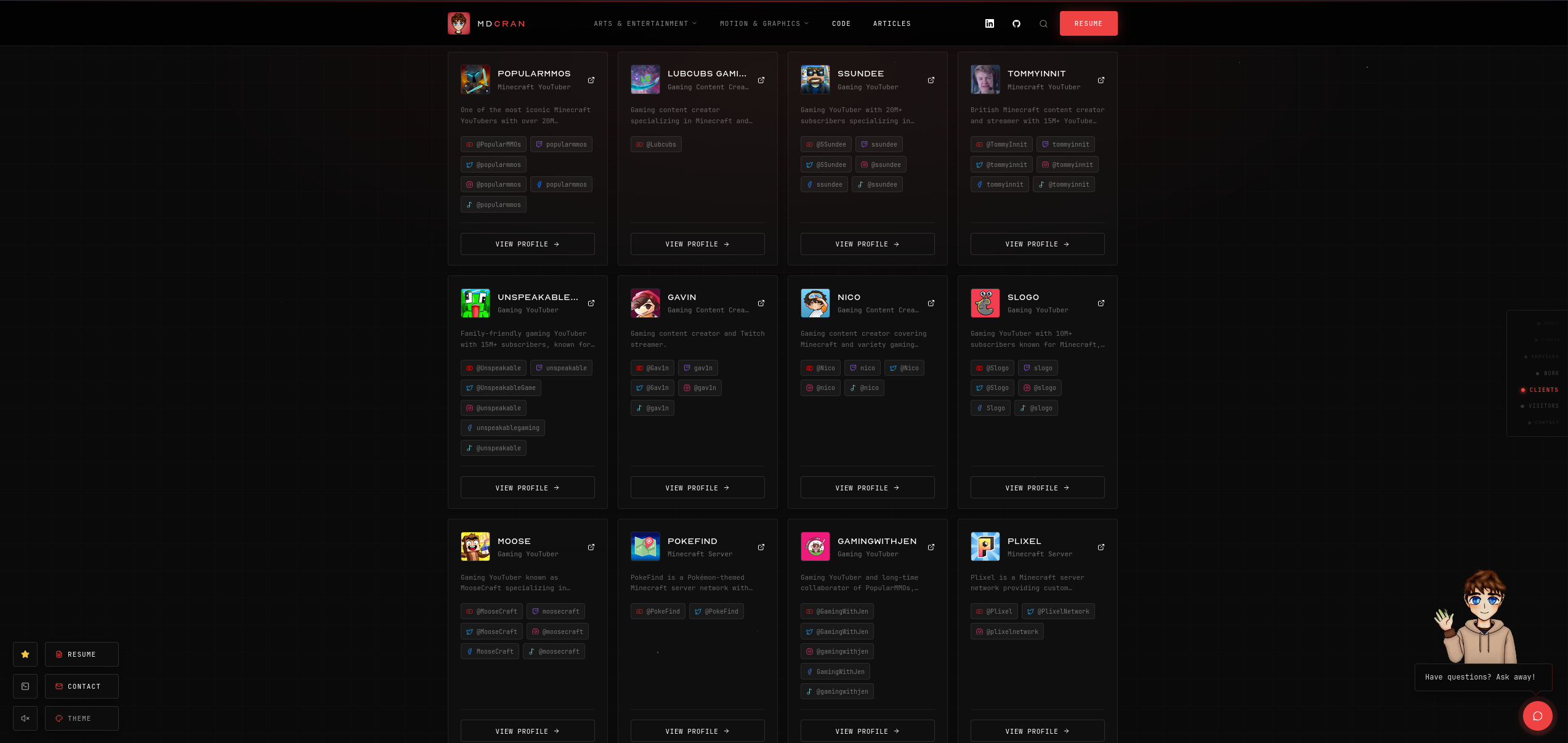
Clients
List of Clients
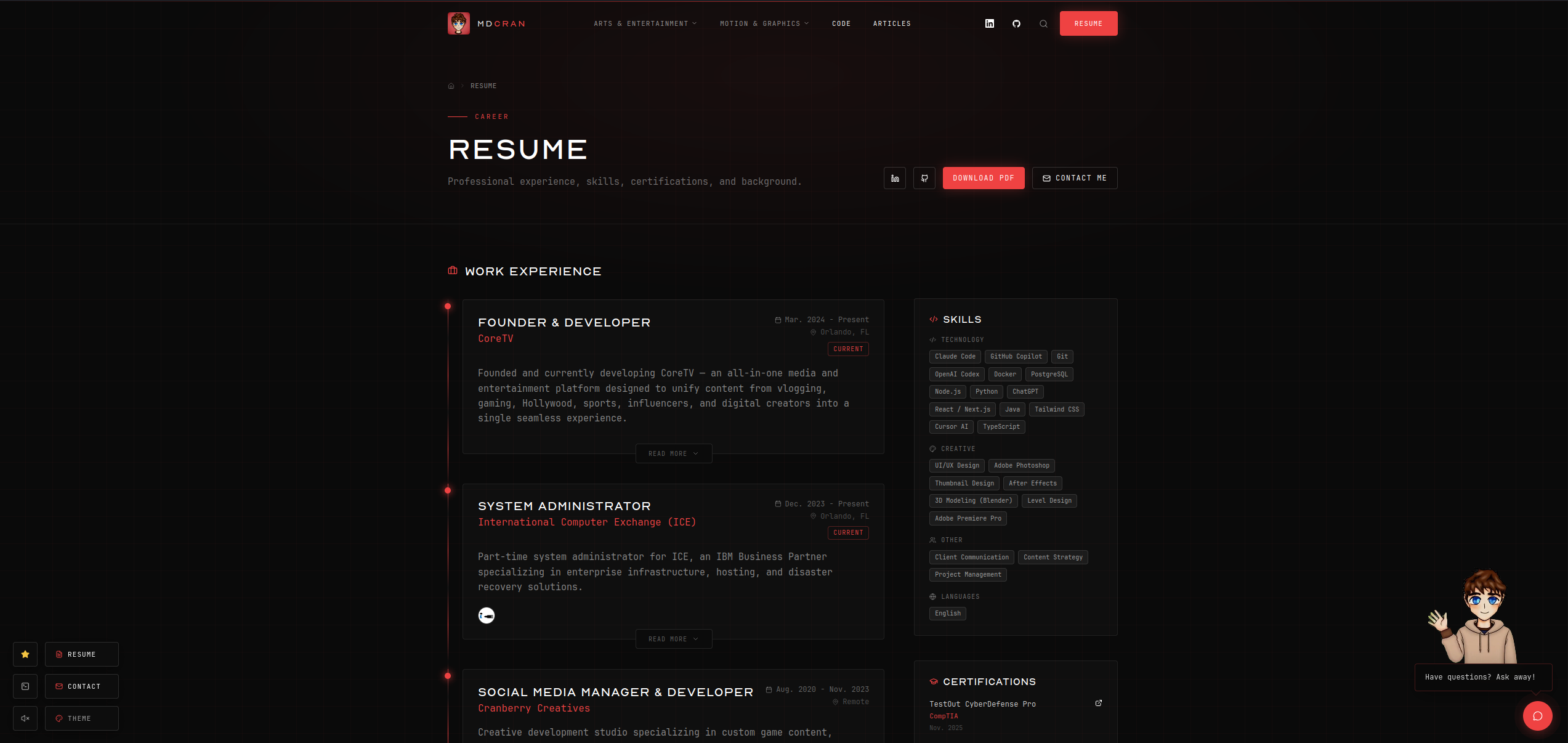
Resume
Up-to-date Resume w/ Experiences, Awards, Organizations, and more...
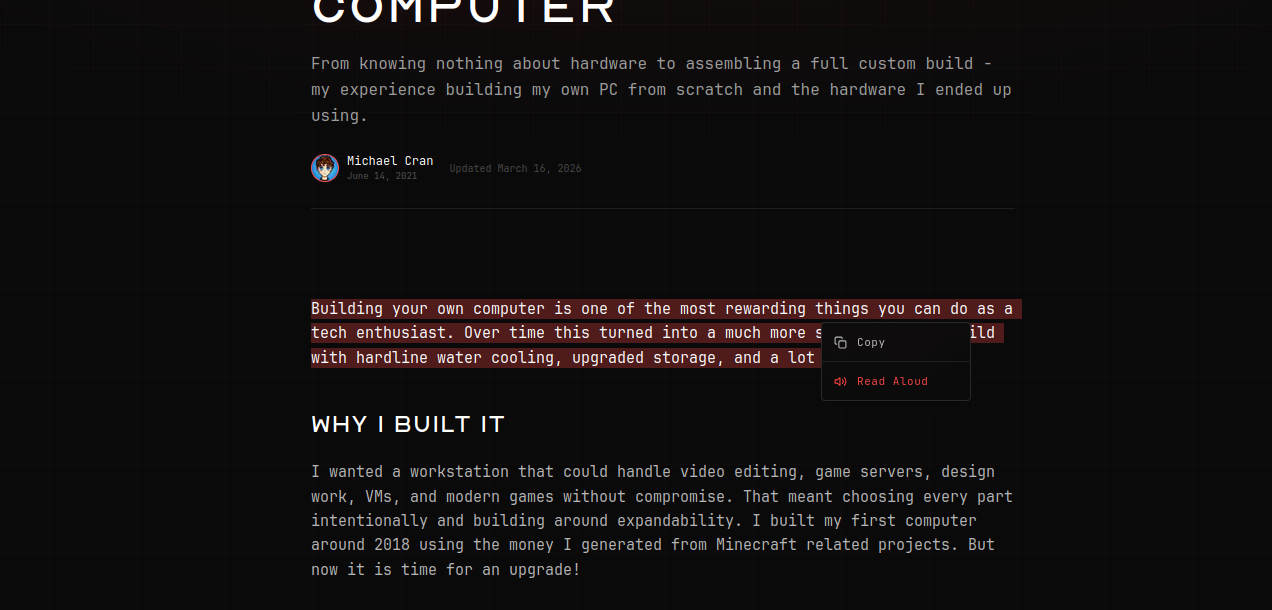
Screen Reader Support
Screen reader technology upon highlighting text.
Custom Themes
Custom themes toggled through bottom left theme selector.
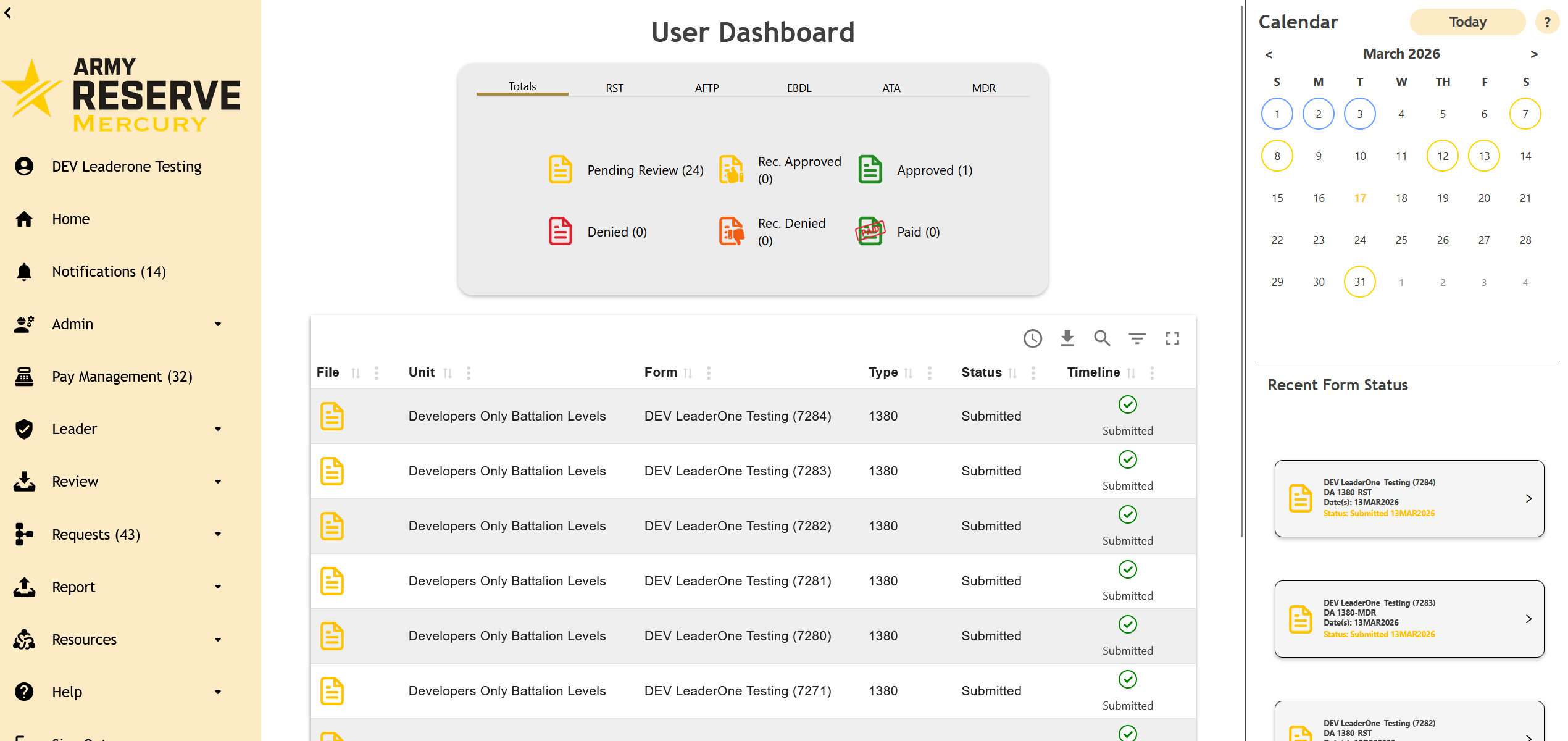
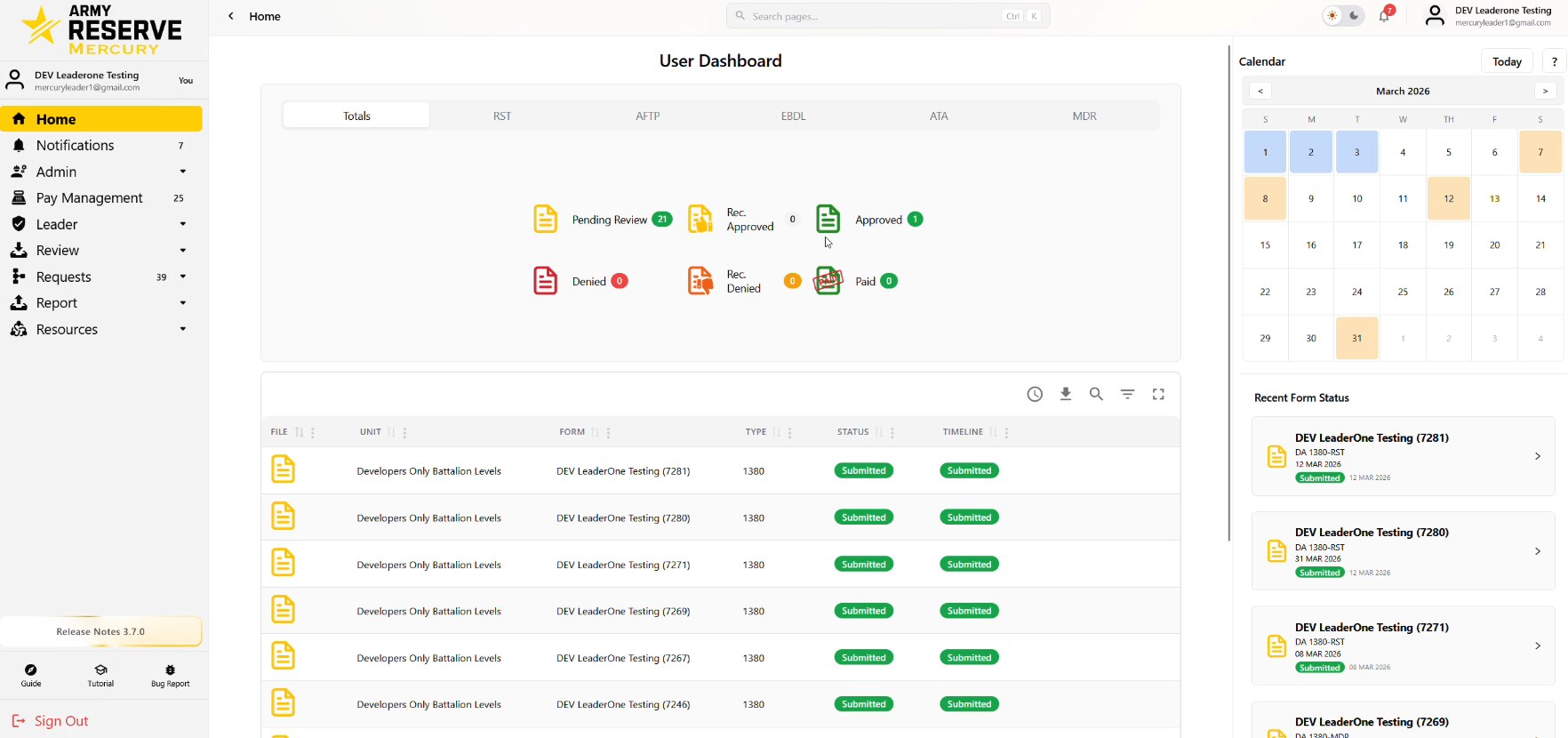
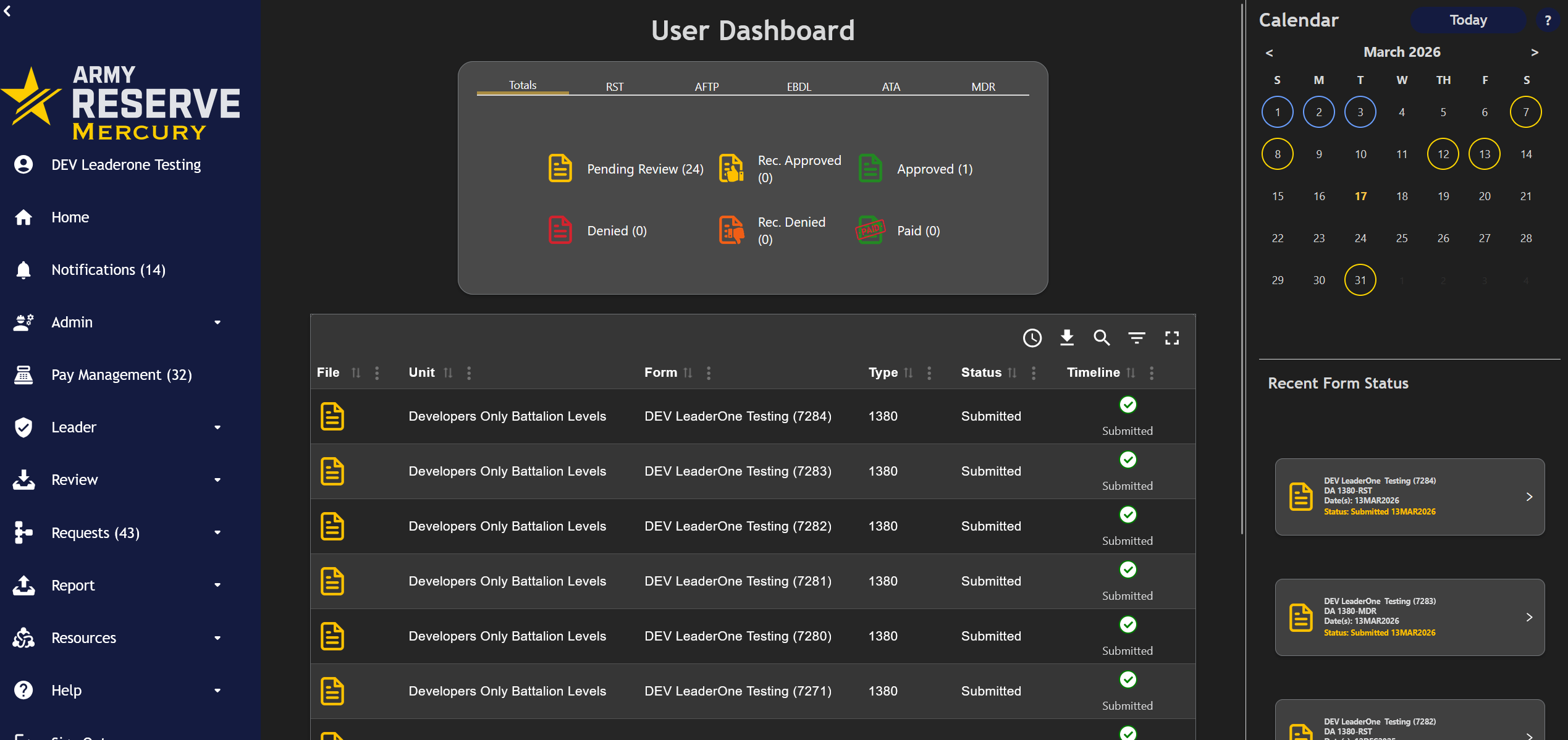
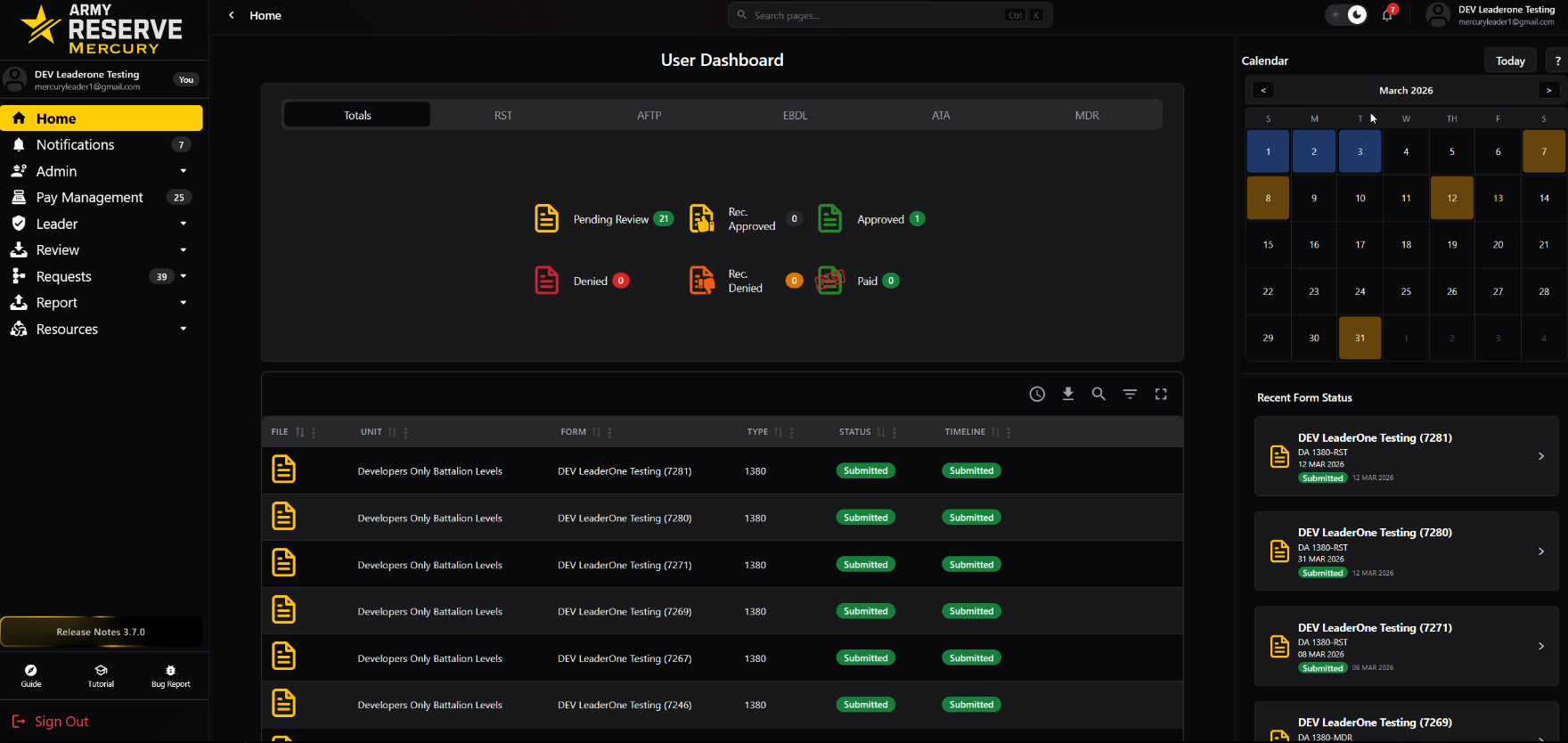
Internal management and operations platform developed for the U.S. Army Reserve, codename Mercury — streamlining administrative workflows and digital communications.
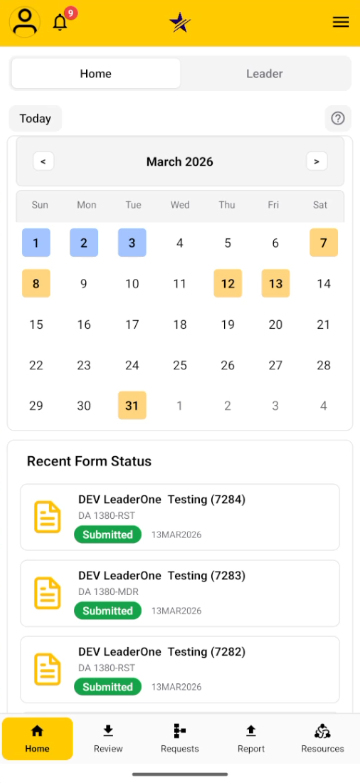
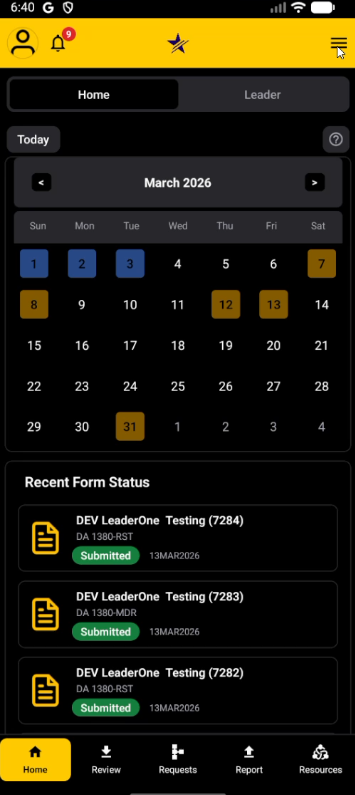
A secure, mobile-accessible forms and operations platform that replaces manual administrative paperwork and supports readiness workflows for Army Reserve units.
Contribution & implementation
Contributed to the web and mobile application and led a UI/UX overhaul across the React and React Native repositories. The project record describes work with military stakeholders in a multi-team engineering environment.
Engineering approach
Modernize administrative workflows with forms and digital communications accessible across devices.
Adopt a reusable, shadcn-inspired component system for React Native interfaces.
Use Reanimated, Moti, Lottie, and React Native Gesture Handler for interface motion and interaction.
Maintain Army Reserve branding and theme colors across web and mobile experiences.
Internal Tool
Government
Operations
Web App
React
React Native
TypeScript
Design systems
Mobile UI
Operations workflows
Full project notes, screenshots & demos +−6 project sections
Reserve Mercury — U.S. Army Reserve Forms Management Platform
Contributed to Reserve Mercury, a large-scale mobile and web platform developed in partnership with the U.S. Army Reserve and National Security Innovation Network to modernize military administrative workflows. The system replaces manual paperwork with a secure, device-accessible solution that improves efficiency and supports operational readiness for thousands of soldiers.
Real-World Enterprise & Government Software Experience
Collaborated within a multi-team engineering environment alongside military stakeholders, designers, and backend developers to build production-grade software with real-world impact. This project reflects experience developing secure, scalable systems in a high-trust, enterprise-level environment supporting U.S. Department of Defense operations.
UI Overhaul
I led a UI/UX overhaul of the web and mobile React Native repositories by introducing ReactNativeReusables to implement shadcn/ui-inspired component architecture for React Native. Integrated advanced animation and interaction frameworks including React Native Reanimated, Moti, Lottie, and React Native Gesture Handler to enhance performance, motion design, and user engagement. Maintained strict adherence to Army Reserve branding and system theme color standards across platforms.
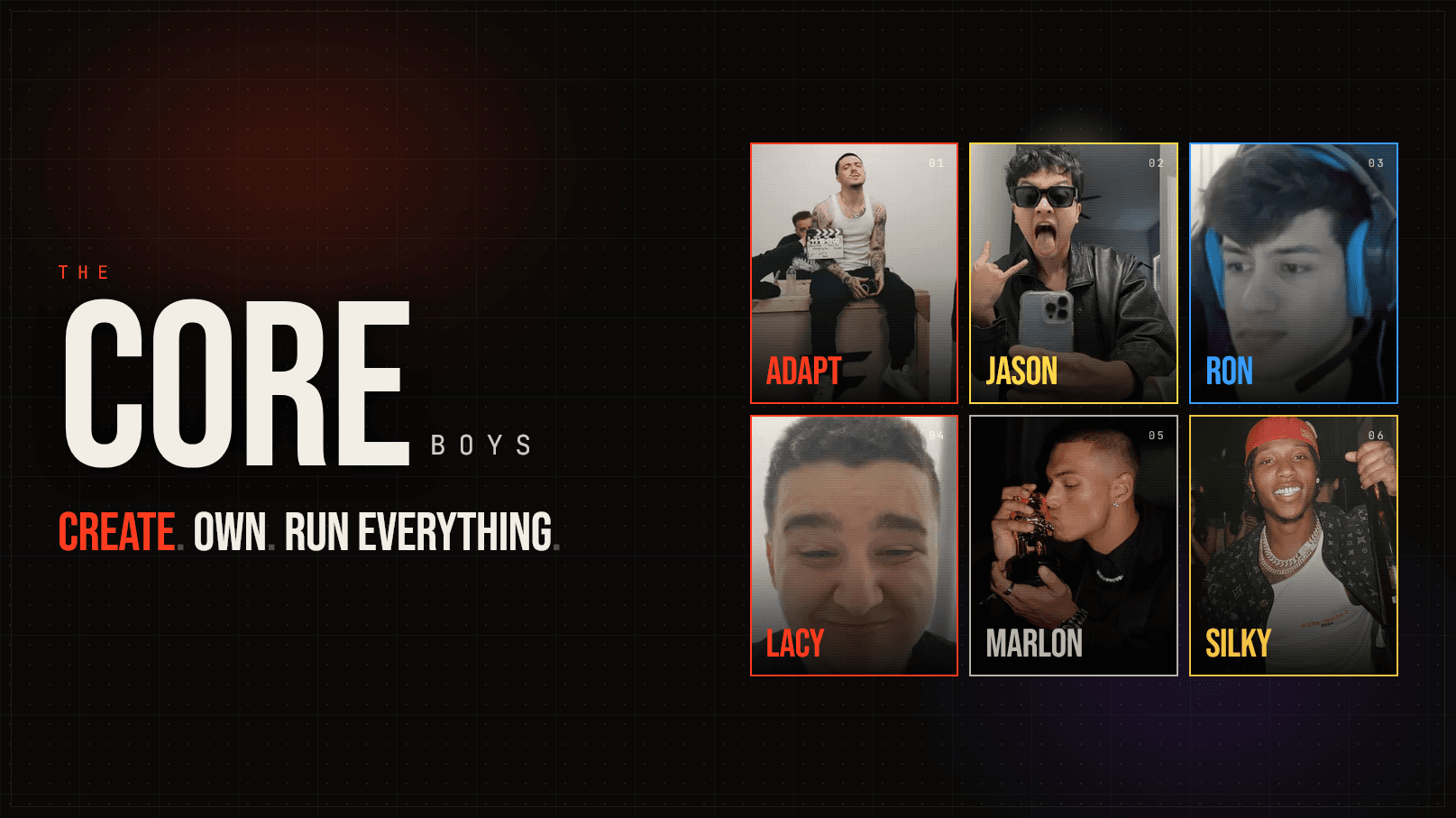
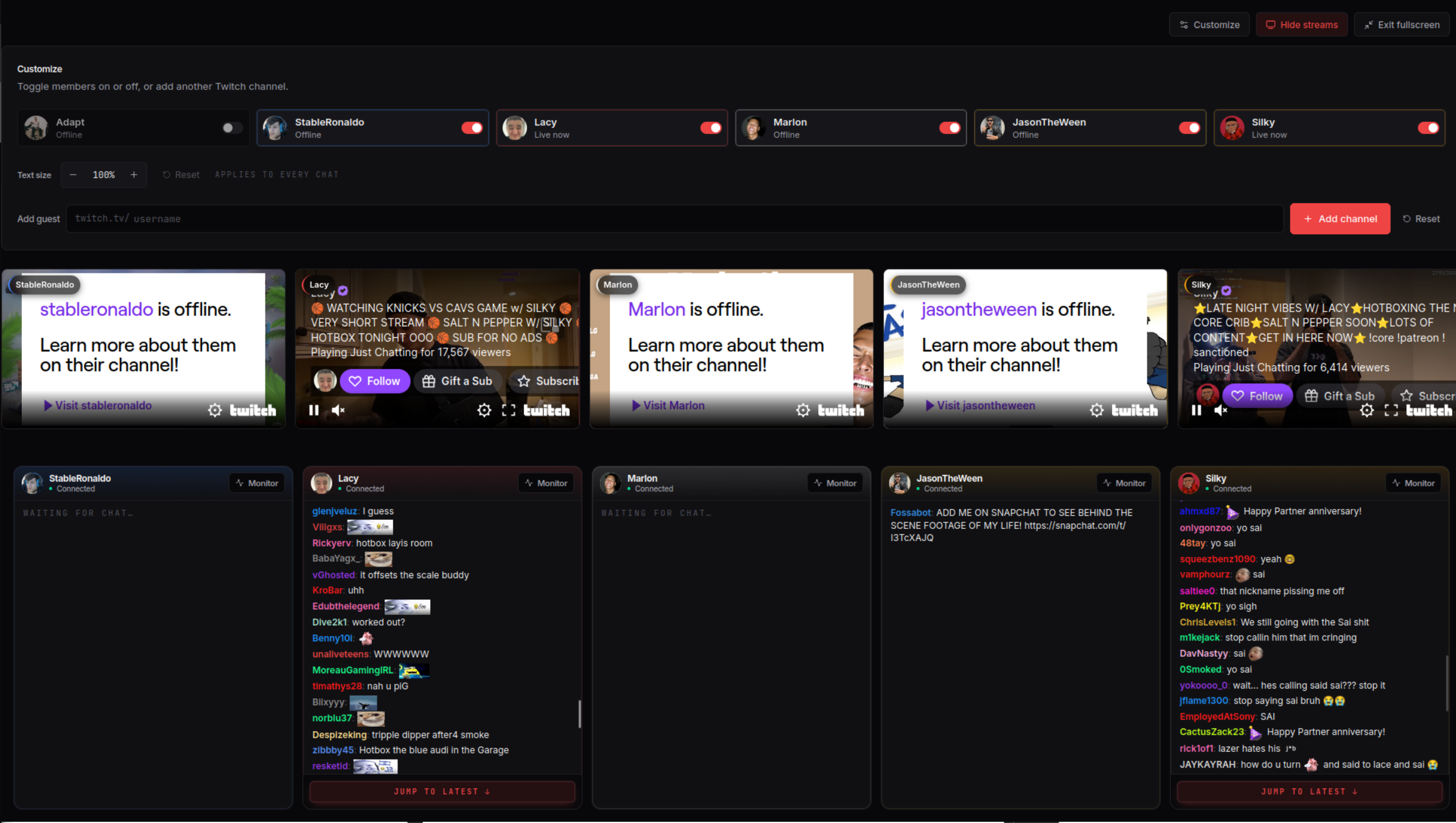
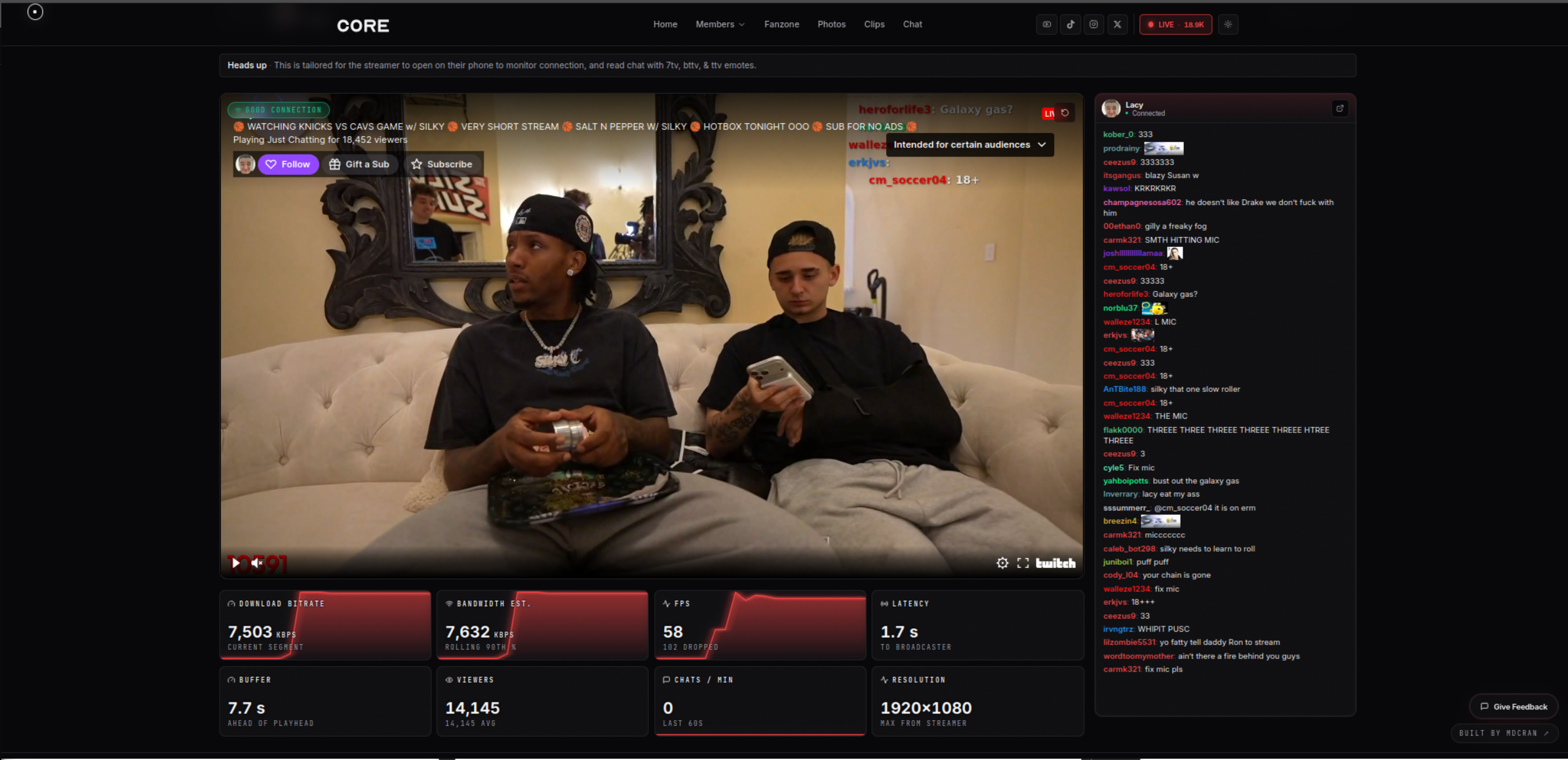
The public-facing landing page for The Core Boys — a six-person creator group. This is a Next.js 15 / React 19 / Tailwind v4 site with a Three.js hero scene, GSAP-driven manifesto reveal, and a live Twitch status integration.
A public landing page for a six-person creator group, combining a Three.js hero, animated manifesto, member roster, and live Twitch status.
Contribution & implementation
Built the Next.js 15 and React 19 experience, organizing the page into seven sections and connecting the roster to a shared Twitch live-status response.
Engineering approach
Compose the experience from focused sections for the hero, manifesto, roster, live status, house reveal, crew, and footer.
Fetch all six member streams in one cached Twitch Helix request and refresh the client view periodically.
Use Zod to validate environment and API inputs, and combine Three.js, GSAP, Framer Motion, and Lenis for the visual experience.
The public-facing landing page for The Core Boys — a six-person creator group. This is a Next.js 15 / React 19 / Tailwind v4 site with a Three.js hero scene, GSAP-driven manifesto reveal, and a live Twitch status integration.
The app composes seven sections: HeroCore, Manifesto, Roster, LiveNow, HouseReveal, Crew, and Footer. Supporting modules provide the Three.js scene, UI primitives, Lenis provider, and Twitch Helix integration.
Twitch integration & dev
The route at app/api/twitch/live/route.ts acquires a cached app-access token, fetches all six member streams in one Helix request, and returns live entries with cache-control. The client refreshes every 60 seconds and derives per-member live dots from the same payload.
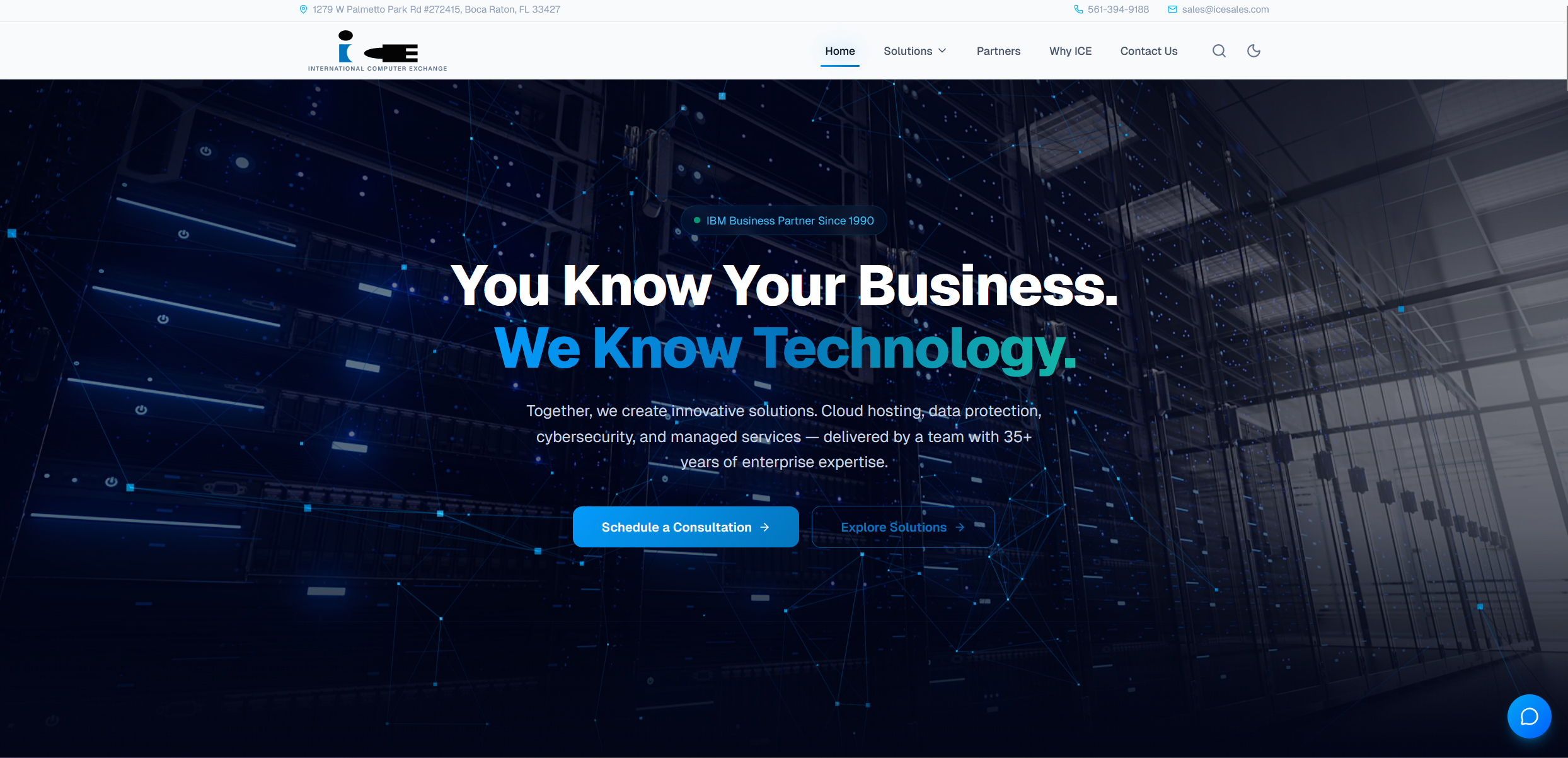
Website design and development for International Computer Exchange (ICE) — an IBM Business Partner specializing in enterprise infrastructure and disaster recovery.
A website for International Computer Exchange, an IBM Business Partner focused on enterprise infrastructure and disaster recovery.
Contribution & implementation
Designed and developed a public-facing business site that explains the company’s enterprise technology focus and gives prospective customers a clear route to learn about its services.
Engineering approach
Center the message on infrastructure and disaster recovery for an enterprise audience.
Use the public site to make the service offering and company expertise easy to review.
Keep the case focused on the shipped website; client infrastructure work remains outside the public project record.
Web Design
Enterprise
Frontend
Web design
Frontend development
Enterprise technology
Disaster recovery
Full project notes, screenshots & demos +−1 project sections
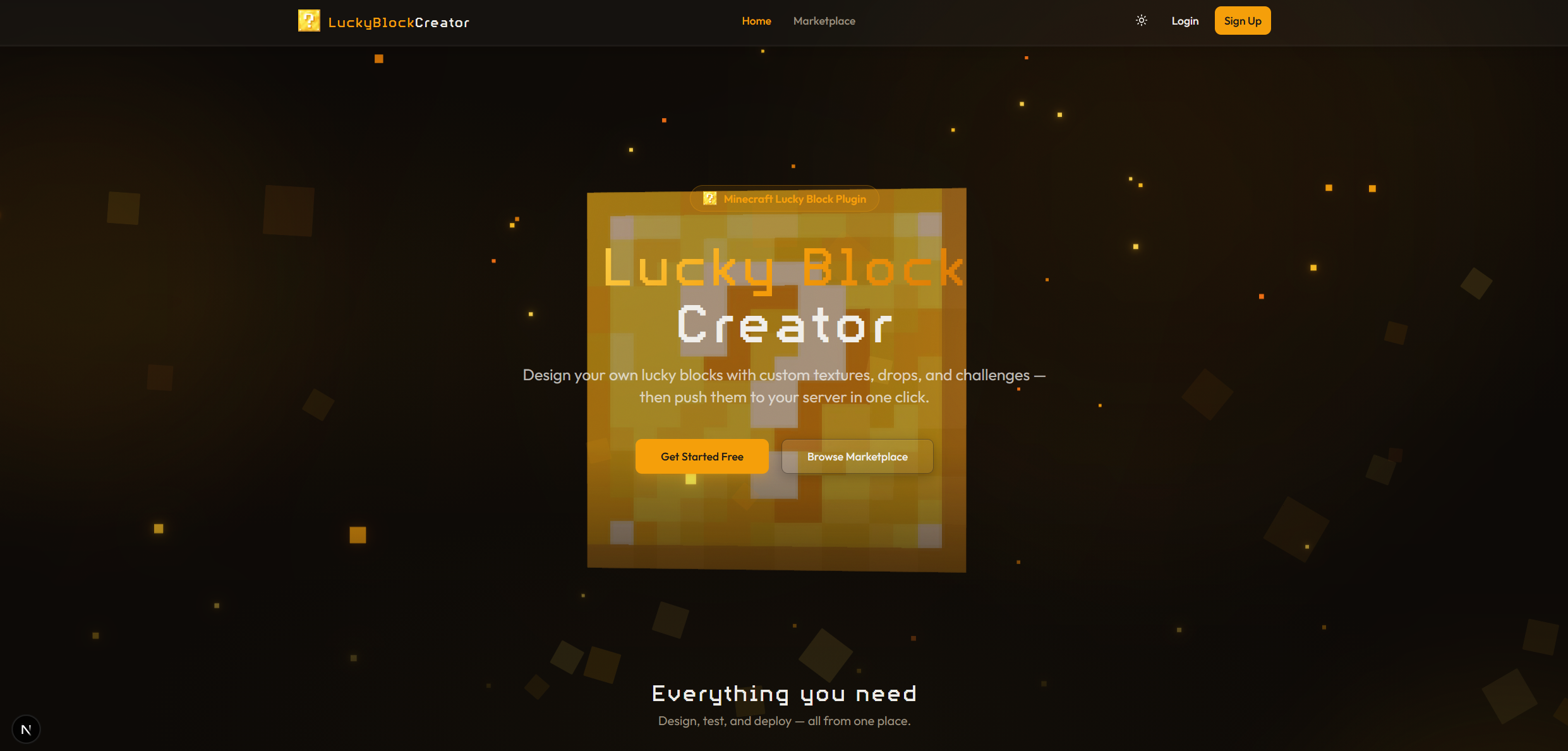
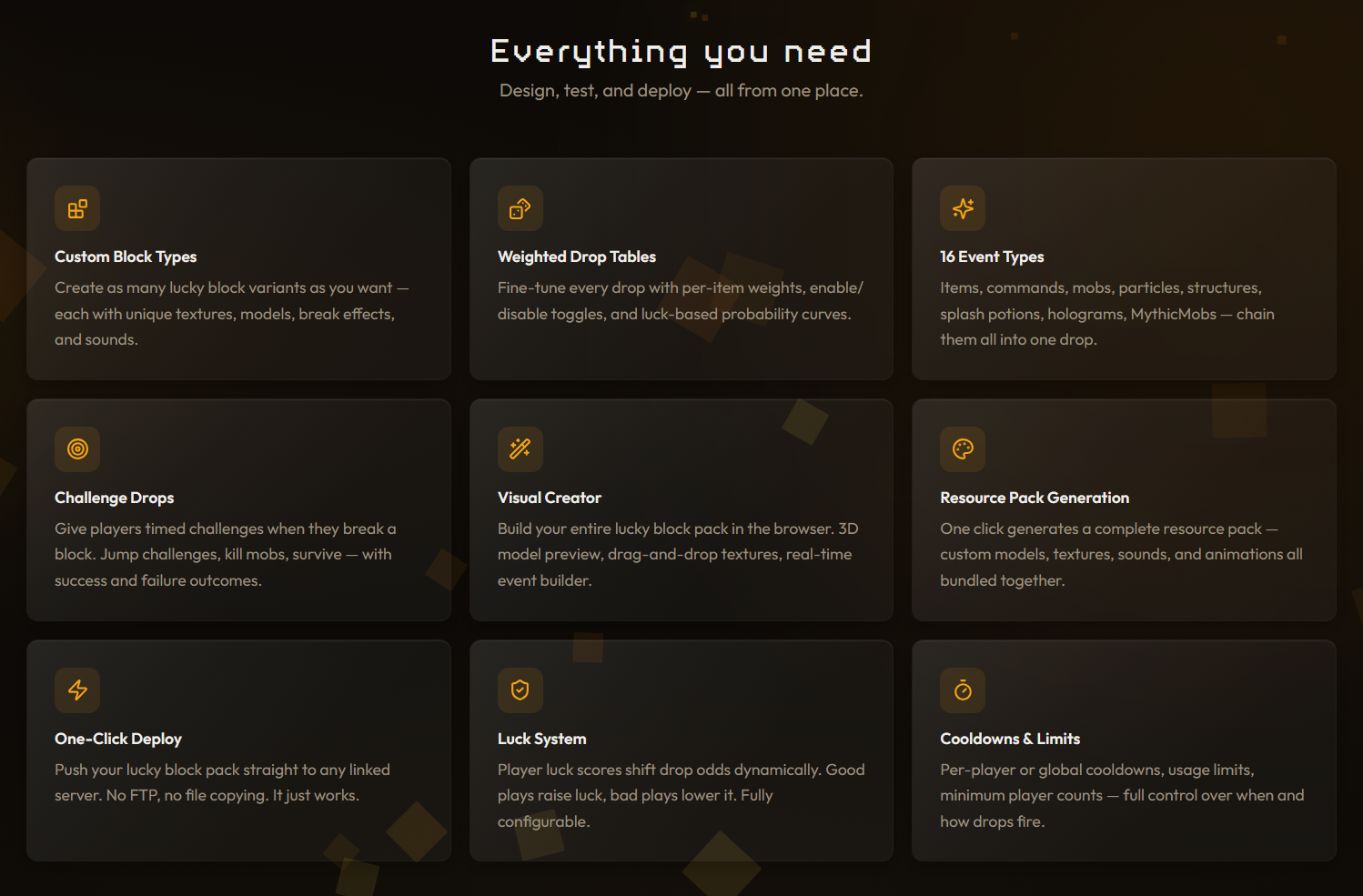
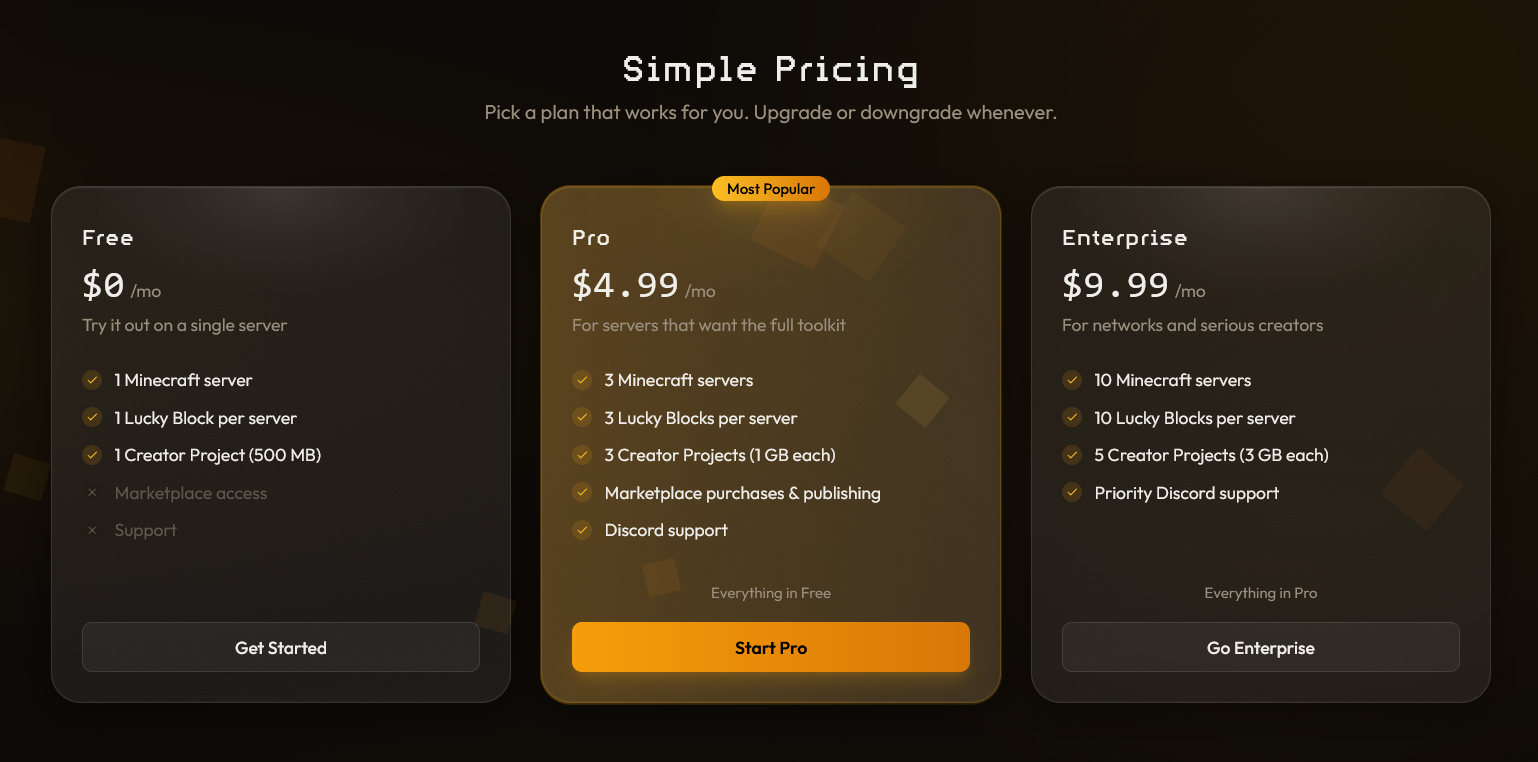
A powerful web-based dashboard that allows server owners to create, customize, and deploy Lucky Block content directly to their Minecraft server.
A web dashboard for Minecraft server owners to create and customize Lucky Block content, then deploy it directly to a server.
Contribution & implementation
Organized the product around the server-owner workflow: configure content, review the result, and move it into deployment from one dashboard. The project page includes interface screenshots and a live product link.
Engineering approach
Keep creation, customization, and deployment in one connected workflow.
Design the interface around server owners who need to manage content without editing server files by hand.
Use a live product and interface captures to make the result reviewable.
Web Design
Frontend
Backend
Web application design
Frontend development
Backend integration
Minecraft tooling
Full project notes, screenshots & demos +−3 project sections
A small provider-neutral package for conversation safety and metered-usage authorization, used at the boundary between applications and private AI services.
Contribution & implementation
Built and maintain reusable input-isolation and authorization contracts for chat, voice, and embedding requests.
Engineering approach
Isolate user-supplied text before it enters a prompt data field.
Require a typed usage-authorization decision before metered operations.
Keep provider SDKs, production policy, prompts, and customer data outside this package.
CoreTV: founder and lead engineer for business technology, AI reception, websites, and workflow automation.
International Computer Exchange: software engineering internship supporting enterprise infrastructure and disaster recovery systems.
Army Reserve — Mercury: secure serverless web and mobile application built in partnership with the U.S. Army Reserve.
Client implementations remain private. The public repositories above provide reviewable examples of my engineering work; my resume covers dates, responsibilities, and qualifications.